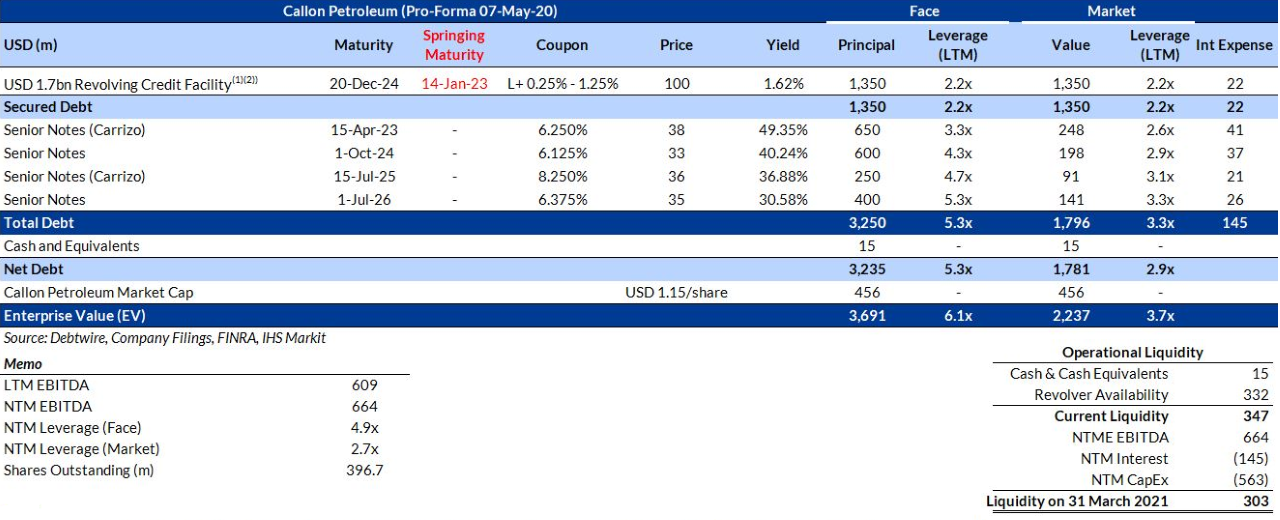
• Callon Petroleum is working with Evercore to shore up its balance sheet after taking a hit during the COVID-19 pandemic, according to two sources familiar with the situation.

    The company could be well positioned to follow Antero Resources’s playbook of selling royalty interests to firm up liquidity, one of the sources added. Management has stated that the company could also pursue divestitures of noncore assets, mineral interests or water assets.

    Callon is one of the many E&P companies that have stumbled on their opportunistic exchange offers of late, as investors have taken a harder stance amid the double whammy of the coronavirus pandemic and depressed commodity market. Holders of the company’s unsecured bonds tapped Rothschild as banker and Paul Weiss as counsel to contend Callon’s now-terminated exchange offer, as Debtwire reported.

    Callon’s USD 650m 6.25% senior unsecured notes due 2023 have sold off over the last month. The notes last traded yesterday (30 June) at 38.106 compared to trades at 47.5 in early June, according to MarketAxess.

    Following the this past spring’s redetermination, Callon’s borrowing base was cut to USD 1.7bn, from USD 2bn. Revolver lenders agreed to provide certain relief, such as suspending the total leverage test until end of March 2022, waiving the current ratio test until 30 September this year, and allowing up to USD 400m of new second lien notes. The borrower is also bound by a total secured leverage test of 3x between 1Q20 and YE21, per the first amendment.

    As of 31 March, the company had USD 347m of liquidity through USD 332m of revolver availability and USD 15m of cash.  The decline in liquidity from 4Q19 of USD 711m was primarily a result of the borrowing base being reduced to USD 1.7bn from USD 2.0bn, negative cashflow of USD 112m, and revolver borrowing of USD 65m, according to a 12 June Debtwire credit report.

    Evercore declined to comment. Callon did not respond to a request for comment.

  • The market took a positive turn for the first day of the third quarter as Pfizer’s coronavirus vaccine showed progress and provided encouragement for travel-related names, according to a buysider and sellsider.

    Preliminary test results of an experimental coronavirus vaccine from Pfizer and BioNtech showed the drug is safe for use and facilitates production of antibodies against the virus. The results fueled expectations for a vaccine for the virus sooner rather than later.

    As far as indices go, the June Purchasing Manager’s Index reading released this morning was up 52.6%, an increase of 9.5 percentage points from May, according to the Institute for Supply Management (ISM). That’s stronger than the consensus estimate of 49.7%, said a credit strategist. 

    While largely good news for an economic recovery in the US, that number likely doesn’t incorporate sentiment from the back half of June when infection rates for coronavirus began to increase in areas that were largely spared during the first wave of the pandemic in the Spring, said the first and a second credit strategist.

    “We’ll have to see the second wave’s impact is on the economy moving forward,” said the second strategist.

    The IG Corporate bond ETF softened 15bps this morning to 134 from 134.15 at open, said the second credit strategist. That’s higher than 123.5 at the start of 2Q20. Meanwhile, the high yield corporate bond ETF was up slightly to 81.67 from 81.41 at open. That’s only a few percentage points higher than the 2Q20 start of 77, said the strategist. 

    The CDX was perhaps the most optimistic indicator, tightening 23bps to 500, from 523.5. The least optimistic was the Dow Jones Industrial Index, which has bounced around 25,800 after an open at 25,979. Tomorrow morning will usher in what is expected to be a strong June, non-farm payroll numbers, said the first credit strategist.

    “The consensus estimate is for non-farm payrolls to be up by a little over 3m,” said the first credit strategist. “

    Travel-related names such as United Airlines and American Airlines strengthened on the renewed expectations of a coronavirus vaccine soon.

    United’s USD 3.8bn 6.5% senior secured notes due 2027 traded today at 101.125 to yield 6.285% from trades at 100.25 to yield 6.493% yesterday, according to MarketAxess. The company’s stock traded today at USD 35.65 per share, up 3% from yesterday’s close and a market cap of USD 10.363bn.

    American’s USD 2.5bn 11.75% senior secured notes due 2025 traded today at 95.25 to yield 13.063% from trades at 94.079 to yield 13.399%, according to MarketAxess. The company’s stock traded today at USD 13.33 per share, up 2% from yesterday’s close and a market cap of USD 6.773bn.

    KIK Custom Products’ loan moved up this morning after the consumer products manufacturer entered into an agreement today to sell its personal care business to Voyant Beauty, according to a sellsider.

    KIK was working with William Blair to find a buyer for its personal care division, as reported last February.

    The USD 919.375m Libor+ 400bps first lien term loan due 2023 was last quoted today in the 97.375/98.375 context from trades at 95/96.088 context yesterday (30 June), according to Markit.

    AMC Entertainment’s loan ticked down this morning in light of reports that advisors to the subordinated noteholders are working on finalizing the terms of a proposed TSA, according to a sellsider and buysider

    The advisors, Milbank and Guggenheim, held discussions with company advisors and two large holders to discuss how to execute the TSA by the end of the week, as Debtwire reported. Meanwhile, some lenders are proposing a counter to further enhance the company’s liquidity, but that offer is predicated on convertible holder Silver Lake swapping into 1.5 lien paper as opposed to first lien paper.

    The company also disclosed that it has extended its early tender deadline, withdrawal deadline and expiration time for holders of the subordinated notes to exchange into 12% cash/PIK second lien notes due 2026. The new deadline is 7 July.

    AMC’s USD 2bn Libor+ 300bps first lien term loan due 2026 was last quoted today in the 69.125/72.375 context, compared to quotes in the 72.313/74.723 context yesterday, according to Markit.

    In the new issue space, PowerTeam Services’ USD 587m 9.033% notes due 2025 traded up this morning after the borrower priced a USD 150m add-on at 100.25 for a 8.962% yield-to-worst yesterday.

    The notes changed hands at 101.875 for a 8.527% yield, up from the offering price but down from 103.25 on 26 June, according to MarketAxess.

    Proceeds from the financing will be used for general corporate purposes, which may include future acquisitions. The borrower raised the initial 2025 notes in May to repay a bridge loan associated with its purchase of MVerge.

    Meanwhile, Enviva Partners’ notes traded up yesterday evening after the company priced its additional USD 150m 6.5% notes due 2026 at 103.75 implying a 5.7% yield to maturity on 29 June. The offering is expected to close on 15 July.

    Its USD 750m 6.5% senior unsecured notes due 2026 traded at 104.27 yesterday yielding 5.106%, up from the offering price but down from 105.27 on 26 June, according to MarketAxess.

  • Recovering from Friday’s dip, the high yield market turned slightly positive this morning as investors digested increases in COVID-19 cases across the country and some states rolled back reopening plans and tightened social distancing standards over the weekend, according to two buysiders and a sellsider. 

    California, Texas and Florida ordered bars to close over the weekend after those states saw spikes in coronavirus cases over the last week. Georgia also joined the list of states that have experienced a surge in cases after reopening.

    The CDX North American HY Index was slightly positive this morning, opening up by 0.12 points and then reversing its gains mid-day, dropping 0.39 points, according to a sellsider.

    Moving in tandem with the overall market, Delta Air Lines’ USD 1.25bn 7.375% senior unsecured notes due 2026 last inched up today to trade at 97.5 to yield 7.937% from trades at 96.53 to yield 8.161% on Friday (26 June), according to MarketAxess. 

    Also propping up the market this morning was Boeing, as its stock climbed after the plane maker received clearance from the Federal Aviation Administration to begin test flights of its 737 Max jet, according to two buysiders. 

    Tests can begin as soon as today (29 June) for the jet, which has been grounded since March 2019 following two plane crashes within the span of five months. 

    Boeing’s stock traded at USD 183 per share this morning, up 7.6% from previous close, for a market cap of 103.2bn. Its USD 650m 3.1% notes due 2026 inched up to 102.397 for a 2.642% yield this morning from 101.993 on 24 June, according to MarketAxess.

    Occidental Petroleum’s new triple-tiered USD 2bn unsecured bond offering traded heavily in the secondary market this morning, said two traders. The company issued the new bonds to fund a tender of near-term bond maturities – most importantly the USD 1.25bn 4.1% unsecured notes due 2021. 

    The company’s USD 1bn 8.875% senior unsecured notes due 2030 traded on USD 213m in volume this morning at par, according to MarketAxess. The company sold the bond via Citi on Friday (26 June). Occidental’s USD 500m 8.5% senior unsecured note due 2027 traded to 99.75 from 99.5 while its USD 500m 8% senior unsecured note due 2025 traded at par from 99.5, said the first trader. 

    Following last week’s bond offer, the company announced this morning that it was increasing the tender offer to USD 2bn from USD 1.5bn, which will further help the company whittle away at the USD 11bn maturity wall coming due over the next 24 months, said the second trader. 

    “Last week’s bond issue showed a clear path for the company,” said the trader. “Pushing out that maturity wall is not exactly a lay-up, but the market isn’t requiring liens right now.”

    The debt load stems from Occidental’s 2019 purchase of Anadarko Petroleum. Occidental shares traded down almost 2% this morning to USD 17.40 per share with a market cap of USD 16bn.

    While Occidental finds a way through the wilderness, Chesapeake Energy did not and landed in the US Bankruptcy Court for the Southern District of Texas over the weekend. The company’s USD 623m 7% senior unsecured notes due 2024 strengthened on news of the filing this morning, to 4.5 from 3.5, said a trader. 

    The company filed with nearly USD 9bn in debt, pushing the corporate default rate to the crucial 5% barrier that Fitch Ratings forecast for the month of June. Corporate default rates haven’t been that high since July 2016 and the energy sector is expected to weather a grueling 17% TTM default rate in 2020, only slightly lower than the 19.7% TTM default rate in July 2017.

  • American Airlines and United Airlines new secured bond deals have diverged in trading as investors express preference for United’s collateral package while coronavirus cases spike back up in regions across the US. At the same time, the lower-credit quality American still faces a hole of up to USD 2.5bn in its expected cash needs through 2021, according to six sources following the company.

    United’s new USD 3.8bn 6.5% senior secured bonds due 2027, backed by its Mileage Plus loyalty program worth roughly USD 20bn, are quoted around par this morning after pricing yesterday at 98.75 to yield 7%, two of the sources said.

    American’s USD 2.5bn 11.75% senior secured notes due 2025, which priced on Wednesday (24 June) at 99, traded as low as the 94 context yesterday before ticking up slightly to 95.375 to yield 13.025% today, according to MarketAxess. American’s bonds are backed by slots, gates and routes, which the company values at USD 7.45bn. 

    Unlike United, American is saving its domestic AAdvantage Program assets to use as collateral for a CARES Act loan structured as a USD 4.75bn Libor+ 350bps TL due 2025. The loyalty program was appraised by a third-party at USD 19.5bn-USD 31.5bn, according to company documents. 

    Even with the new USD 2.5bn bonds, USD 1.9bn in new equity and converts and USD 4.5bn CARES Act loan, American will still likely need roughly USD 2.5bn in capital to get to the end of 2021, estimated two of the sources. That would address its massive cash burn of up to USD 10bn in 2020 and USD 2bn in 2021, along with more than USD 5bn in maturities through the end of next year. 

    By 30 June, American expects to have USD 11bn in liquidity, assuming the USD 4.75bn secured CARES Act loan is funded in June, the filings state. 

    In a 27 April report, Debtwire affiliate Xtract Research estimated the company had USD 24bn in debt capacity, before drawing on its 364-day loan or the CARES Act funding from the government. 

    American’s liquidity situation became more dire in April, with the company drawing USD 2.7bn on the revolver, offset by receiving half of the allotted assistance or USD 2.9bn under the federal Payroll Support Program. 

    More recently, the company has reduced its costs significantly and announced that it is planning to fly 55% of its domestic schedule and nearly 20% of its international schedule in July 2020 compared to the same period last year.

    Because of the increased flying schedule, American is projecting a deceleration in cash burn to USD 40m per day in June, compared to USD 100m per day in April. The company is aiming to reduce that cash burn figure to zero by the end of 2020, according to the 12 June operational update. 

    New issues volumes rise as travel stays low 

    While high yield bonds and equity have been taken for a spin by the regularly changing sentiment toward pandemic recovery, new issuance has consistently grown since April – culminating in a frenzy so far in June, sources said. 

    At least 64 high yield issuers have priced bonds and loans since 1 June, according to Debtwire data. Since last Monday (15 June) alone, more than 55 issuers have either launched or priced deals. 

    On the airline front, JetBlue pushed through a loan offering on 15 June, while Delta Air Lines also came back to the market for an unsecured notes offering on 10 June.  

    While Delta was able to tap the market in April for a secured notes offering, the company returned to the market earlier in June for USD 1.25bn 7.375% senior unsecured notes due 2026. 

    Both airlines’ new debt has traded off over the last few days, in line with American’s new bonds, due to the travel implications of a spike in coronavirus cases across the country. 

    American is specifically exposed to a second wave of the pandemic, especially in Texas and California, with 30% of its May bookings coming from the former and 10% from the latter, one of the sources said.

    Thursday marked the worst day of new coronavirus infections in the US, with Florida, Texas, Oklahoma and South Carolina reporting their highest single day-totals on Wednesday. In response to the increases, New York, New Jersey and Connecticut called for a 14-day quarantine for visitors traveling from states experiencing spikes.

    JetBlue’s USD 750m L+525bps first lien TLB due 2024 traded today in the 98/98.9 context, compared to trades at 99.833/100.333 earlier in the week and 99.65/100.125 context last week (19 June), according to Markit.

    Delta’s USD 1.25bn 7.375% senior unsecured notes due 2026 traded today at 97 to yield 8.052%, compared to trades at 101 to yield 7.149% last week and a 99.986 issuance price, according to MarketAxess. 

  • The high yield market opened weaker this morning as investors digested this week’s spikes in coronavirus cases across the country and a higher-than-expected jobless claims number, according to a buysider and sellsider. 

    Wednesday marked the worst day of new coronavirus infections in the US, with Florida, Texas, Oklahoma and South Carolina reporting their highest single day-totals. In response, New York, New Jersey and Connecticut called for a 14-day quarantine for visitors traveling from states experiencing spikes.

    Adding to the downward sentiment, the latest jobless claims report showed weekly unemployment claims worse than expected, with first-time claims for the insurance at 1.48 million last week, compared to the expectation of 1.32 million.

    While investors welcomed new deals from airliners American Airlines and United Airlines earlier this week, the increase in cases and jobless claims has turned investors more bearish on the recovery prospects of the travel sectors, the sources said. 

    Priced yesterday, American’s USD 2.5bn 11.75% senior secured notes due 2025 fell three points today to 96 to yield 12.848%, according to MarketAxess – after issuing at 99. 

    United’s USD 2bn term loan due 2027 and USD 3bn secured bonds due 2027 in the market have yet to price, but its USD 148m 4.75% senior unsecured notes due 2022 ticked down to 98.25 to yield 5.482% from trades at 98.75 to yield 5.223% yesterday, according to MarketAxess. 

    Hertz unsecured bond prices began to fall in line with the recent CDS settlement auction. After fluctuating over the past week, the bankrupt car rental company’s USD 800m 5.5% unsecured bond due 2024 traded this morning at 29, down from 40 on 16 June, while its USD 500m 6.25% unsecured bond due 2022 also fell to 29.5 from 43 over the same period.

    “The bonds are aligning themselves with the auction results,” said one bondholder.

    The price for protection mirrored the recent fall in the bond prices ahead of the auction, with five-year CDS on the name widening 15 points to 73 points up front over the week prior to the auction. The Hertz CDS auction settled yesterday at 26.375, resulting in a roughly 74 cent pay-out to buyers of protection, said the bondholder.

    Rite Aid’s debt and equity jumped this morning as the retailer launched an exchange offer for up to USD 750m of its outstanding 6.125% notes due 2023 for newly issued 8% senior secured notes due 2026 and cash. 

    Those participating by the 9 July early deadline will get USD 800m of new notes and USD 194m in cash for every USD 1,000 notes. Those tendering after that deadline but prior to 23 July expiration date will receive USD 760m of new notes and USD 184m in cash for USD 1,000 notes. 

    The targeted USD 1.15bn 6.125% senior unsecured notes due 2023 traded up three points today to 98 for a 6.936% yield from 95 yesterday while its stock jumped 20.5% from previous day’s close to USD 15.52 for a market cap of roughly USD 872.1m.

    CEC Entertainment’s notes dropped this morning after the family entertainment company filed for Chapter 11, according to a sellsider familiar. 

    The company closed venues and suspended operations in response to the COVID-19 pandemic, which led to the hiring of advisors for the company, bondholders and an ad hoc group of lenders, as previously reported.  

    The USD 215m 8% senior unsecured notes due 2022 last traded today at 3.5, down from trades at 14.5 on Tuesday (23 June), according to MarketAxess. 

    In new issuance, Meredith Corp’s unsecured notes traded down slightly this morning as the issuer launched a new USD 300m senior secured notes offering due 2025. 

    The offering is part of a proposed USD 710m in new financing that the issuer plans to use to redeem all its outstanding Series A preferred stock. The media conglomerate intends to raise the remainder of new debt in the form of incremental term loans.

    Its USD 1.2bn senior unsecured 6.875% notes due 2026 fell a point to 88 for a 9.704% yield compared to 89 yesterday, according to MarketAxess. Its common shares traded at USD 14.23 this morning up 0.4% from yesterday’s close for a USD 645.9m market cap. 

  • Cruise liner debt and equity swooned this morning after Norwegian Cruise Lines (NCL) announced that the majority of its cruises will remain suspended until at least 30 September, according to a trader and sellsider.

    Norwegian, Royal Caribbean and Carnival in mid-March suspended voyages and have incrementally extended the extensions since then, while the Centers for Disease Control’s most recent no-sail order is through 24 July.

    Carnival had laid out a plan in May to potentially resume North American cruises from ports in Florida and Texas from 1 August, while Royal Caribbean CEO Richard Fain also said on CNBC he hopes to resume sailing on 1 August. 

    Norwegian’s announcement, late yesterday (16 June), shows a slower recovery in cruise activity than some investors had hoped for, sources said. 

    While NCL’s debt remained muted this morning, its stock declined 7% to USD 19.48 per share and a market cap of USD 4.99bn. 

    Royal Caribbean’s USD 1.15bn 4.25% senior unsecured notes due 2023 fell nearly six points to 104.53 yielding 2.663% from trades at 110.045 to yield 0.843% yesterday (16 June), according to MarketAxess. The USD 500m 3.7% senior unsecured notes due 2028 traded today at 69.25 to yield 9.374% from trades at 72.5 to yield 8.64% on 11 June. 

    RCL’s stock last traded today at USD 57.69 per share for a market cap of USD 12.051bn, down 7.70% from yesterday’s close. 

    Carnival’s stock also traded down 6.19% on the day in tandem with its peers to USD 19.16 per share and a market cap of USD 15.023bn. 

    Hertz bonds fell further today as SEC Chairman Jay Clayton disclosed that the regulator has issues with the bankrupt car rental company’s plan to sell stock in lieu of raising DIP financing to fund operations through bankruptcy, according to three buysiders.

    Moreover, yesterday the agency’s former chairman, Harvey Pitt, said that underwriter Jefferies could be exposed to liability in connection with the offering. 

    The debtor’s bonds already erased some of their earlier gains after Hertz on Monday filed to sell a smaller-than-expected USD 500m in new equity. Hertz’s disclosures on Monday stated that new equity investors may receive nothing from an eventual bankruptcy plan after bondholders and other debtholders are paid. 

    Hertz’s USD 800m 5.5% senior unsecured notes due 2024 traded at 37.938 this morning compared to 42.75 yesterday, while its USD 500m 7.125% senior unsecured notes due 2026 fell to 37.5 today from 43 yesterday, according to MarketAxess.

    Hertz’s stock traded today at USD 1.94 per share and a market cap of USD 276.05m, down 0.51% from yesterday’s close. 

    CoreCivic’s bonds ticked down after the private prison company announced it will suspend its quarterly dividend and evaluate corporate structure and capital allocation alternatives, according to two buysiders. 

    The company has hired Moelis along with Bass, Berry and Sims and Latham and Watkins to assist in the evaluation, the press release states. 

    The company said that the suspension of the dividend will not impact its REIT status for 2020 as it plans to reduce its minimum contribution commitment through the CARES Act. However, the two sources interpreted the move as a first step to changing the company’s REIT status moving forward. 

    CEO Damon Hininger highlighted the company’s programs including “GED, vocational education, substance-abuse treatment and job placement assistance.”

    “At this point, the company is reacting to the current news cycle and trying to show that it is part of helping improve the incarceration system as opposed to profiting from it,” one of the sources said. 

    CoreCivic’s USD 250m 4.75% senior unsecured notes due 2027 traded today at 90.5 to yield 6.394%, down from trades at 91.5 to yield 6.205% on 3 June, according to MarketAxess. Meanwhile, the company’s stock fell 18.37% to USD 10.22 per share today and a market cap of USD 1.229bn. 

    Overall, the recent market rally and positive sentiment driven by government stimulus has spurred high yield new issue activity and trading performance on the break, according to two sellsiders. At least seven high yield deals launched yesterday, followed by eight more today, according to Debtwire data. 

    DCP Midstream debt inched up this morning as the energy company launched an offering for its USD 400m senior notes due 2027, with net proceeds marked for general corporate purposes, including debt repayment and funding capital expenditures. 

    Its USD 600m 5.125% senior unsecured notes due 2029 traded up this morning to 98.5 for a 5.338% yield compared to 97.75 yesterday. Its stock traded at USD 13.92 for a market cap of USD 2.9bn this morning, up 2.96% from yesterday’s close.   

    Dana’s newly issued USD 400m 5.625% senior unsecured notes due 2028 inched to 101.313 today for a 5.322% yield versus 100.75 yesterday. The automotive borrower issued the notes due 2028 on 15 June to partially repay its revolver. Its USD 300m 5.375% senior unsecured notes traded up to 102.75 this morning yielding 4.676% compared to 101 on 12 June.

    Ford’s newly issued USD 1.75bn 5.125% senior unsecured notes due 2025 climbed up to 101.25 this morning for a 4.837% yield after pricing at par yesterday, according to MarketAxess. Proceeds from the financing were slated for general corporate purposes.

    Comstock Resources’ USD 500m 9.75% non-fungible add-on notes due 2026 jumped up to 93.25 this morning for a 11.31% yield after issuing at 90 for an all-in yield of 12.096% yesterday, according to MarketAxess.

    Similarly, Standard Industries’s USD 1.1bn 4.375% senior unsecured notes due 2030 changed hands at 100.875 yielding 4.245% this morning after allocating at par yesterday. Proceeds from the financing were slated to redeem its USD 1.1bn 5.375% senior unsecured notes due 2024. The notes due 2024 traded in size at 101.5 for a 4.709% yield on 11 June.

  • Staples’ adjusted EBITDA cratered in 1Q20 as demand for office supplies fell due to coronavirus (COVID-19) pandemic-related shutdowns, according to three sources familiar with the matter.

    The company reported a 42.6% year-over-year decline in adjusted EBITDA to USD 135m for the 1Q20 period, the sources said. Meanwhile, quarterly revenue slid 8.6% YoY to USD 2.4bn, they added.

    Gross margins fell 19.4% YoY on weakness of home deliveries, one of the sources said.

    While the company sought to cut costs through employee furloughs and reducing executive compensation, its adjusted margin is projected to decline between 50bps – 100bps in 2020, according to a Standard & Poor’s note from 8 May.

    Its adjusted leverage will likely exceed 8x this year and 7x in 2021, due to the economic recession and demand headwinds from the COVID-19 pandemic, according to S&P. The ratings agency downgraded Staples’ senior debt to B from B+ and the unsecured debt to CCC+ from B- on concerns of elevated leverage and cash flow pressures.

    “Staples entered the current economic recession with a highly leveraged balance sheet and limited financial flexibility to withstand an extended economic downturn,” the S&P analysts wrote.

    Still, Staples’ liquidity remained ample at USD 840m as of 2 May, through USD 577m of cash and USD 263m of ABL availability, two of the sources said.

    The USD 2bn Libor+ 700bps term loan due 2026 softened to the 91.547/93.469 context from 92.213/94.1 yesterday, according to Markit. Meanwhile, the USD 300m L+ 450bps term loan due 2024 was relatively unchanged at 93.063/95.063.

    The USD 2bn 7.5% senior secured notes due 2026 traded at 92.5 to yield 9.187% today, while the USD 1bn 10.75% senior unsecured notes due 2027 changed hands at 70 to yield 18.694% today, consistent with recent levels, MarketAxess shows.

    Sycamore declined to comment. Staples did not respond to a request for comment.

  • Shutterfly posted mixed results for the quarter ended 31 March, with the core consumer business ticking up year-over-year, while Lifetouch lagged due to school closures, according to two sources familiar with the company. The company also received USD 62m in new cash equity from investors during the quarter, one of the sources and an additional source added. 

    The core consumer business is also up 30% in orders for April and May, the sources added. The segment raked in USD 157m of revenue in 1Q20, compared to USD 149m in 1Q19. 

    Lifetouch, on the other hand, did well revenue-wise the first two months of the quarter, but fell prey to the effects of the pandemic in the last month and ended the quarter down 30% to USD 90m from USD 130m the prior year, the sources noted. 

    During the quarter, management also increased its cost savings target through 2022 to USD 120m from USD 85m. The company also expects an additional USD 85m of cost savings generated in response to COVID-19 through a reduction in labor costs, salary and other cuts for the year, the sources said. 

    Including the recently completed Snapfish acquisition, Shutterfly generated USD 331m of pro forma revenue during the quarter, compared to USD 376m year-over-year. The company generated USD 286m of that on a standalone-basis. 

    On the bottom line front, Shutterfly booked negative USD 60m of combined adjusted EBITDA in 1Q20, compared to negative USD 38m in 1Q19, the sources said. On an LTM basis, the company generated USD 426m of combined credit agreement adjusted EBITDA versus USD 430m as of LTM 31 December. Including the expected COVID-19-related cost savings, LTM pro forma adjusted EBITDA totals USD 511m. 

    As of 31 March, liquidity stood at roughly USD 280m through USD 80m of cash and USD 200m of revolver availability. On a net basis, the company is levered 4x through the term loans and 4.7x total, based on USD 426m of combined LTM EBITDA, the sources said.

    “It’s important to note that the highlight of our recent performance is the tremendous strength in our core consumer business.  The 30% growth in orders for April and May is significant, versus single digit growth in recent years, and we are very pleased with that performance and trajectory,” a Shutterfly spokesperson said.

    Shutterfly’s USD 750m 8.5% senior secured notes due 2026 changed hands at 94.375 to yield 9.71% on 11 June, down from a print at 97.75 to yield 8.97% before the report, according to MarketAxess. 

    The bonds were placed as part of a financing package backing an LBO by Apollo Management. The company faced a difficult syndication process, including several rounds of revisions and a postponement, before Apollo bought USD 300m of the bonds and the underwriters carved out a separate pro-rata tranche to hold on to for six months.

    Shutterfly also made a USD 100m prepayment of its term loans during the quarter, as reported. The loan facility contained a provision requiring a USD 100m paydown if the company’s cash balance at year-end totaled USD 350m or less. The paydown was applied across both the underwriter and institutional tranches.

    The Libor+ 600bps institutional tranche – USD 775m at issuance – was traded down to the 90.7/92.43 context yesterday (15 June), down from trades in the 91.813/94.688 on 9 June before the earnings report, according to Markit. Originally issued at a 95 OID, the loan recovered today to the 91.417/93.192 context. 

    Apollo did not respond to a request for comment. 

  • Hertz’s bonds and equity erased some of Friday’s gains this morning after the bankrupt car rental company filed to sell a smaller-than-expected USD 500m in new equity, according to two buysiders and one sellsider. The bonds initially bounced on Friday after the company announced it would seek – and did ultimately receive – court approval to issue up to USD 1bn in equity.

    In its disclosures to potential new equity investors today, the company warned that those investors may receive nothing from an eventual bankruptcy plan after bondholders and other debtholders are paid.

    “There is a significant risk that the holders of our common stock will receive no recovery under the Chapter 11 Cases and that our common stock will be worthless,” the filing states. 

    Hertz’s USD 900m 6% senior unsecured notes due 2028 last traded today at 42.75 from trades at 48.5 late Friday (12 June), according to MarketAxess. The same notes traded at 40.5 early Friday.

    Its Libor+ 275bps TLB due 2023 is quoted in the 87.179/89.598 context today, compared to the 88.036/90.607 context on Friday, according to Markit. 

    The company’s stock traded today at USD 2.29 per share for a market cap of USD 326.452m, down 19.24% from Friday’s close. 

    The acrimonious unravelling of Cineworld’s acquisition of Cineplex has left investors in both capital structures facing near-term uncertainty. Both movie theater operators have accused the other of not meeting contractual obligations necessary to close the deal, and Cineplex said on Friday (12 June) that it will pursue legal action against Cineworld. 

    UK-based Cineworld in February syndicated a USD 1.9bn L+ 300bps (0% floor) term loan B due 2027 to help fund the USD 2.1bn purchase price of Cineplex, a Canadian operator. However, the company never drew on the escrow to purchase Cineplex, said a loan trader. 

    The February loan was quoted this morning at 67/71, said the trader. Meanwhile, Cineworld’s legacy USD 3.3bn L+ 250bp term loan B due 2025 softened on the news, to 76/79 today from 78/81 on Friday, said the trader. 

    Cineworld’s stock traded up 3% today to GBP 78.94 with a GBP 1bn market cap. The stock began the year at GP 220.00 per share. 

    Meanwhile, Cineplex stock dropped 16% today to CAD 11.50 and a CAD 727m market cap, from CAD 13.79 per share at market close on Friday.

    Cineworld’s attempt to back out of the merger was foreshadowed earlier this spring when a group of Cineworld lenders retained Houlihan Lokey and Arnold & Porter Kaye Scholer to help analyze the transaction and a means to exit the deal because of a dramatic change in the operating environment for movie theaters. Cineplex disagrees with Cineworld’s repudiation and noted that the agreement between the two companies excludes termination events including “outbreaks of illness or other acts of God.”

    Meanwhile, in bankruptcy news, Skillsoft and 24 Hour Fitness loans softened as they filed for Chapter 11 protection this morning.  

    Skillsoft filed for Chapter 11 with a restructuring support agreement backed by a majority of its first and second lien lenders following a missed interest payment last month. The RSA outlines a plan to reduce the company’s debt to USD 410m from roughly USD 2bn. 

    The educational technology company’s USD 1.23bn L+ 475bps (1% floor) first lien term loan due 2021 softened to the 59.036/62.893 context this morning compared to the 60.839/65.339 context on Friday (12 June), according to Markit. 

    24 Hour Fitness filed for bankruptcy with plans to secure a USD 250m DIP, citing the pandemic for its balance sheet problems. The company retained Lazard, FTI and Weil Gotshal as its advisors earlier this year for a restructuring. 

    The gym operator’s USD 850m L+ 350bps term loan due 2025 is quoted at 26.35/30.825 versus 27.797/32.063 on 12 June, according to Markit.

    Extraction Oil & Gas also filed for bankruptcy this morning after retaining restructuring advisors earlier this year. Though its debt did not trade on the news, the issuer’s stock is down to 54 cents this morning and a market cap of USD 75.4m, down 15% from Friday’s market close. The debtor has secured USD 125m in DIP financing consisting of USD 50m in new money.

    In capital raising news, United Airlines’ bonds strengthened slightly while its equity softened after the airline announced it has received loan commitments of up to USD 5bn, backed by the company’s MileagePlus loyalty program, according to two buysiders and a sellsider. 

    To counteract the company’s expected cash burn, United plans to have USD 17bn in liquidity at the end of 3Q20, including proceeds from the new term loan, an undrawn USD 2bn revolver and USD 4.5bn available under the federal CARES Act loan program. 

    While both loans will provide the company with much-needed liquidity, layering is still a concern for existing lenders and bondholders, two of the sources said.

    United’s USD 400m 4.25% senior unsecured notes due 2022 last traded today at 86.5 to yield 11.082%, compared to trades at 86.375 to yield 11.143% on Friday, according to MarketAxess. Its USD 300m 5% senior unsecured notes due 2024 gained a point to trade at 83.5 yielding 10.6% from 82.5 yielding 10.98% on Friday.

    Its USD 1.485bn L+ 175bps TLB due 2024 is quoted today in the 90.95/93.35 context compared to 91.438/93.813 on Friday, according to Markit. 

    The company’s stock traded today at USD 37.26 per share for a market cap of USD 10.967bn, down 6.05% from Friday’s close.

  • High yield bonds and equity declined this morning after Federal Reserve Chairman Jerome Powell disclosed Wednesday the Fed’s decision to hold rates steady until 2022 amid reports that COVID-19 cases are rising in many states, according to two buysiders and sellsider.

    Fed officials projected a slow economic recovery from the effects of the pandemic. They indicated that they expect an unemployment rate of 9.3% at the end of 2020, along with elevated unemployment for years, coming in at 5.5% at the end of 2022, according to media reports.  

    The US hit two million confirmed coronavirus cases on Wednesday, with spikes in hospitalizations around the country in Texas, Arizona, Arkansas, Florida and California, fueling fears of a second spike in cases of the virus.

    The Dow Jones Industrial Average fell more than 1,300 points, or 4.95%, so far today from yesterday’s close.

    As such, many of the same travel and leisure names that rode the market rally over the last week are now plummeting, the sources said.

    Most visible was AMC Entertainment, whose sub bonds shot up yesterday by as much as 10 points on the theater operator’s optimistic reopening comments – but gave back some of those gains this morning.

    AMC’s USD 595m 5.875% senior subordinated notes due 2026 fell five points to 38 for a 26.441% yield compared to yesterday’s high of 43 while its USD 600m 5.75% subs due 2025 dropped to 36.5 from 42, according to MarketAxess.

    The issuer’s USD 475m 6.125% sub notes due 2027 fell to 36.438 this morning after gaining six points yesterday to reach 41.

    Its stock fell to USD 5.07 this afternoon for a USD 528.5m market cap, down 19.3% from yesterday’s close.

    Royal Caribbean Cruises’ USD 500m 3.7% senior unsecured notes due 2028 traded down today to 72.5 to yield 8.64% from trades at 77.25 to yield 7.638% on 9 June, according to MarketAxess. The company’s stock traded today at USD 58.95 per share for a USD 12.34bn market cap, down 7.3% from yesterday’s close.

    Boeing’s USD 5.5bn 5.805% senior unsecured notes due 2050 traded down to 115.578 to yield 4.809% today from trades at 117.289 to yield 4.712% before the announcement, according to MarketAxess. The company’s stock fell to USD 187.34 per share for a market cap of USD 106.21bn, down 7.9% from yesterday’s close.

    Ford’s USD 750m 3.815% senior unsecured notes due 2027 shed nearly three points to trade today at 89.75 to yield 5.524% from trades at 92 to yield 5.128% on Tuesday (9 June), according to MarketAxess. Its USD 1bn 9.625% senior unsecured notes due 2030 traded today at 116 to yield 7.279% from trades at 118.75 to yield 6.921%. The company’s stock fell to USD 6.35 per share for a market cap of USD 25.264bn, down 6.75% from yesterday’s close.

    In addition, high yield new issues have come under pressure this week. Ten bonds have priced week-do-date through Wednesday, according to Debtwire data, and all of them softened today although some remain above their issue prices.

    For example, Delta Air Lines’ USD 1.25bn 7.375% senior unsecured notes due 2026, issued at par yesterday, traded today at 98.5 to yield 7.707%, according to MarketAxess. The company’s stock traded today at USD 28.80 per share for a market cap of USD 18.395bn, down 8.98% from yesterday’s close.

    International Game Technology’s USD 750m 5.25% senior unsecured notes due 2029 traded today at 98.25 to yield 5.508% from trades at par yesterday, after pricing at par on 8 June, according to MarketAxess. The company’s stock last traded at USD 8.94 per share for a market cap of USD 1.829bn, down 9.74% from yesterday’s close.

    CenturyLink subsidiary Level 3 Financing’s USD 1.2bn 4.25% senior unsecured notes due 2028 softened to 99.625 to yield 4.305% today, compared to a par issuance price, according to MarketAxess. CenturyLink’s stock traded down today to USD 9.91 per share for a market cap of USD 10.90bn, down 7.42% from yesterday’s close.

    Realogy‘s USD 550m 7.625% second lien notes due 2025 traded today at 100.25 to yield 7.551%, after popping to the 102-102.25 range upon pricing, according to MarketAxess. The notes were issued on Tuesday at par. The company’s stock traded at USD 6.65 per share for a market cap of USD 767.21m, down 15.18% from yesterday’s close. 

    In earnings news, Tailored Brands’ term loan softened this morning after the issuer provided preliminary financials for 1Q20 ended 2 May and requested a 45-day extension to file its Form 10-Q for the quarter due to disruption caused by the pandemic. The retailer reported a 60.4% year-over-year in net sales for the quarter to USD 286.7m and drew down an additional USD 310m under its credit facility.

    Its USD 900m Libor+ 325bps (1% floor) TL due 2025 softened to 22.4/26.4 context today compared to 23/26.8 yesterday, according to Markit.

    Lenders to the company have retained Houlihan Lokey and Gibson Dunn in anticipation of balance sheet restructuring talks, while the company is working with PJT and Alix Partners.

    Equinox’s existing term loan softened by about two points over the last few days, as the company raised a USD 150m L+900bps (1% floor) TLB due March 2024 in a club deal led by BofA.

    Its USD 1.01bn L+300bps TLB due March 2024 traded down to 80.375/82.875 this morning from 82.55/84.2 yesterday, according to Markit.

    Grubhub’s bonds gained more than three points this morning after the borrower reached a deal to be acquired by  European food delivery company Just Eat Takeaway for USD 7.3bn yesterday.  

    The issuer’s USD 500m 5.5% senior notes due 2027 climbed to 103 this morning for a 4.822% yield after trading at 99.875 yesterday. Meanwhile its stock is trading at USD 62.17 this morning for a market cap of roughly USD 5.7bn, up 5.4% from market close. 

    The all stock-deal values Grubhub at USD 75.15 per share, marking a 27% premium to its closing price of USD 59.05 on Tuesday (9 June).