• Immucor EBITDA and revenue declined year over year in 2Q19, according to two sources familiar with the matter. The company will host an investor call at 2pm today to discuss the results, one of the sources added.

    The transfusion and transplantation products maker disclosed USD 30.9m of EBITDA for the quarter, down 15% year-over-year. The company reported USD 32.3m of EBITDA, down 14% from USD 37.6m for the corresponding period, excluding a quarterly cash injection the borrower made to biotech spinoff Sentilus Holdco.

    Immocor’s revenues for the quarter totaled USD 92.6m, down 5%, driven by a decline in sales in the transfusion division, the sources said. On a like-for-like basis, revenue ticked down 1% for the quarter due to fewer shipment days in the quarter, another source said.

    The results left the TPG Capital-owned company levered roughly 7.8x, based on LTM EBITDA of around USD 136.5m and USD 1.06bn of total debt, according to the sources.

    The company bought biotech company Sentilus in 2014 and then spun it off in 2016. Immucor now holds a management service agreement with Sentilus requiring Immucor to fund Sentilus’ research and development. Relatedly, sponsor TPG infused a USD 13m cash injection into Sentilus last year.

    “The fact that TPG is putting in money should make people less concerned about the Sentilus add-back. We think that TPG will continue to support them,” one of the sources said.

    As of 30 November, Immucor’s liquidity stood at roughly USD 43m, with USD 38m of revolver availability on its USD 70m revolving credit facility due 2020 and around USD 5m in cash, the sources said.

    The company’s debt structure includes USD 390m 11.125% senior unsecured notes due 2022, a USD 625m L+500bps (1% floor) first lien term loan due 2021 and two smaller USD 6m term loans due 2019 and 2020, according to one of the sources.

    The notes last traded yesterday at in the 101/102 context, in line with recent levels, the sources said. The revolver was last quoted in the 98.18/99.18 context today, down from the 99.805/99.555 context before the earnings report, according to Markit.

    TPG Capital declined to comment. The company did not respond to a request for comment.

  • As the first US issuer to bring a high yield bond since 29 November, the Targa Resources driveby was met with overwhelming demand by investors watching for signs of more deals to come. However, the midstream producer will pay a premium for its oil and gas exposure and for breaking open the paralyzed market, according to multiple buyside and sellside sources. 

    Although high yield investors are itching to put their cash to work, this BB-rated deal may not mean the new issue market is wide open yet for lower-quality credits, especially with the risk of more macroeconomic volatility and fluctuations in the price of oil on the horizon, said the sources.

    Targa fits the profile for early 2019 issuers given the higher ratings and its upcoming maturity this year that needs to be addressed.

    “This deal shows the market is modestly open, but the early round of new issuers will probably have to price at nice discounts,” said a buysider. “For those with 2019 and 2020 maturities, and loans that got hung up, they are watching.”

    Led by BofA Merrill Lynch, Targa launched final pricing for a USD 750m senior unsecured deal due 2027 at 6.5%, tight of official talk in the 6.625% area. Thanks to investor demand, BofA added an upsized second tranche in the afternoon of USD 750m senior unsecured notes due 2029 that launched at 6.875%, in line with official price talk in the 6.875% area.

    Proceeds will be used for general corporate purposes, which may include working capital, funding growth investments and acquisitions, and repaying existing debt, including notably the partial or full redemption of the outstanding USD 749m 4.125% senior unsecured notes due 15 November 2019, which traded today at par, up from 99.875 yesterday and the 99 area throughout December, according to MarketAxess.

    At a 6.5% coupon, the Ba3/BB 8.5-year tranche offers investors a premium of almost 100bps to Targa’s existing USD 1bn 5.875% notes due 2026, which traded today at 101.625 to yield 5.513%, tighter versus 96.75 yielding 6.44% on 3 January, according to MarketAxess.

    The new deal is also at a premium to Targa’s USD 500m 5.375% senior unsecured notes due 2027, which traded Tuesday (8 January) at 96.875 to yield 5.867%. 

    The upsizing also signals the high yield market is thawing, sources said. “We’re hoping this opens up the market…that this is the deal to assuage other issuers and banks that it’s okay to come to high yield again, but they may just have to pay a little more,” said a sellside origination source.

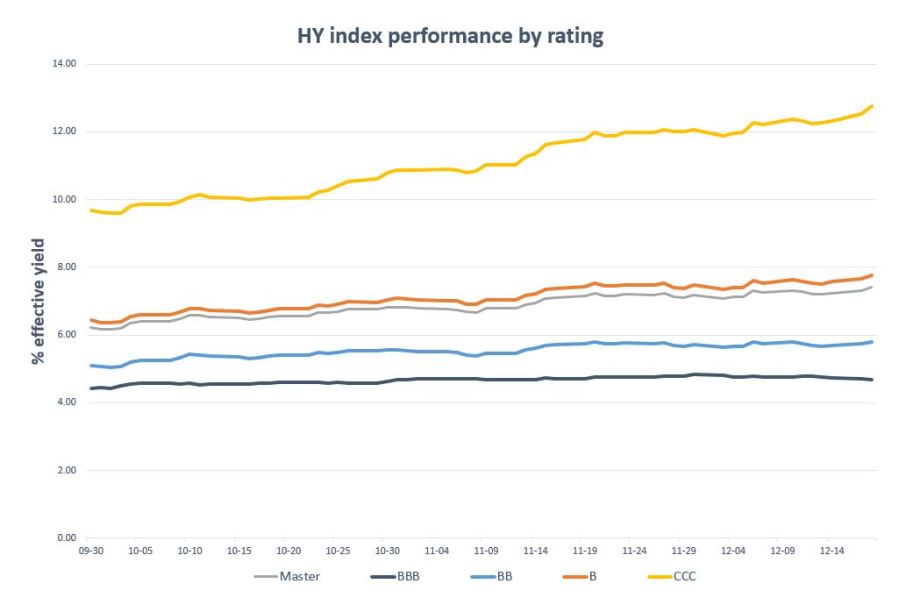
    The rally over the last week has brought the effective yield on the ICE BofAML US High Yield Master II Index back to early-December levels. The effective yield was 7.13% yesterday (9 January), a yield last seen on 4 December. It hit a peak at 8.05% on 26 December. 

    For relative value to Targa’s new bonds, buysiders pegged Targa to price wide of fellow midstream operators 4.1x-levered DCP Midstream and 4.7x-levered NuStar Logistics.

    DCP’s Ba2/BB USD 500m 5.375% senior unsecured notes due 2025 last traded today at 101.25 to yield 5.14%. NuStar’s Ba2/BB USD 550m 5.625% senior unsecured notes due 2027 last traded yesterday (9 January) at 95.75 to yield 6.289%, according to MarketAxess.

    Targa’s target

    As a midstream company, Targa is more insulated from the impact of volatile oil price than E&P names. Still, combined with the recent rise in oil prices, it could begin to crack the window open for better-quality E&Ps, sources speculated.

    “As long as production’s not falling…[Targa is] fine,” said a buysider.

    Pro forma the deal, Targa’s liquidity increases to USD 2.27bn with USD 931.6m in cash and USD 1.34bn of availability on a USD 2.2bn revolving credit facility due 2023, up from USD 1.53bn of liquidity before the transaction, according to deal documents.

    The company is in the middle of an expansion project and will continue to burn cash even though organic growth capex will decrease to USD 2bn in 2019 from USD 2.4bn in 2018. In FY19, Targa will burn roughly USD 855m of cash, using Street-estimated USD 1.534bn in adjusted EBITDA, about USD 2bn of capex, according to guidance, and estimated USD 389m pro forma interest expense, not factoring in future debt repayment.

    “[They] will start to reap EBITDA and revenue contribution from the extra capex from extra pipelines and processing plants,” a buysider said.

    Before factoring in debt repayments, the deal increases total leverage by more than a turn to 5.9x, based on USD 7.56bn in pro forma total debt and USD 1.28bn of LTM 30 September adjusted EBITDA, according to deal documents.

    BofA declined to comment. Targa did not respond to a request for comment.

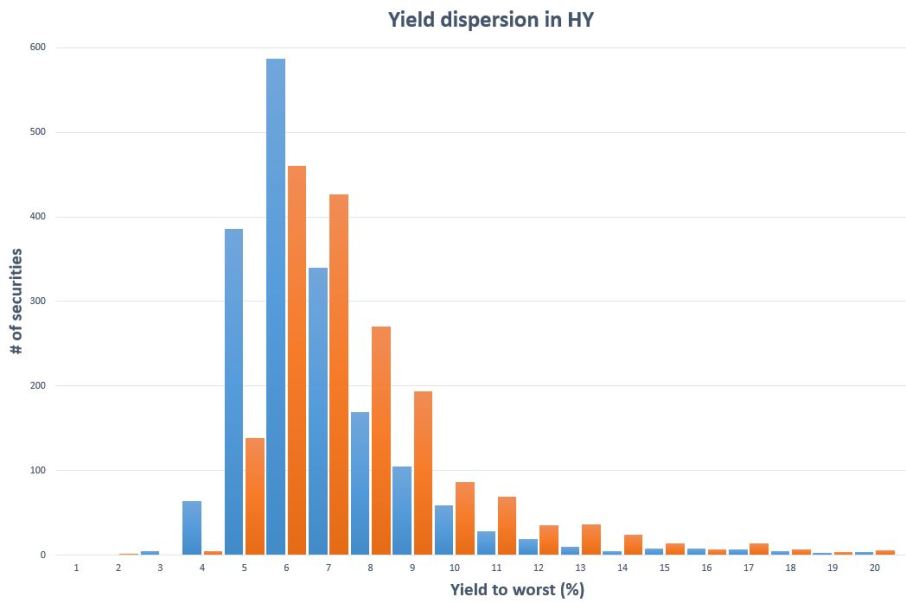
  • High yield investors are becoming pickier as a looming recession, global trade tensions and falling oil prices continue to weigh on high yield spreads despite historically low year-end supply. Increased dispersion between credits is set to be a defining theme for 2019, 10 buysiders told Debtwire.

    After a sustained selloff in the third quarter that shuttered primary markets early, bonds in the ICE BofAML HY index are now spread across a wider range of yields, with substantially more names trading in the teens compared to the end of the third quarter.

    One portfolio manager likened it to the final weeks of 2014, when high yield investors rushed to rebalance their portfolios amid a burgeoning crisis among energy issuers: “It’s the same playbook. Guys have got to sharpen their pencils again.”

    Just USD 4.95bn in of US high yield bonds pricing since 1 November—down 88% from the same time period last year, when USD 40.3bn of new deals were closed, according to Debtwire data. Issuance had already dropped off a cliff by the time Mercer International priced the last new deal of the year.

    This lack of new supply has done little to support secondary trading, however, with the ICE BofAML high yield index widening 124bps to an effective yield of 7.42% since the beginning of October, as investors fret over lower economic growth projections, plunging oil prices and global geopolitical tension.

    Markets plummeted again on Wednesday and Thursday after the Fed raised interest rates by another 25bps and signalled more hikes in 2019. But economic fundamentals are broadly judged to be relatively strong, making investors are reluctant to pull too much cash out of the market.

    That makes individual credit analysis of paramount important going into 2019, said a trader: “If you’re trying to keep up with any benchmark, you’ve got to make your bets. It’s going to come down to credit selection and avoiding landmines.”
    (Source: ICE BofAML HY Master index)

    Quick shift

    In a market where sentiment can shift rapidly and take a whole sector down or up with it, the fundamental credit-by-credit analysis becomes even more important, leading toward an emphasis on higher-rated credits and shorter-dated maturities, sources said.

    But the selloff has also led to a “shoot first, ask questions later” mentality for selling on the first hint of negative news.

    “The market has just been so punishing to any kind of downside negative news or perception that selling on the first down-trade has probably saved you further pain in the following days, weeks, months,” the trader said.

    The volatility has also crimped liquidity, meaning investors have had to re-evaluate the extent of their conviction around credits, particularly among smaller names.

    “Names that might have had some yield and might be good performers and smaller, we have to have much more conviction in those names because flows have been atrocious,” they said.

    Break the cycle

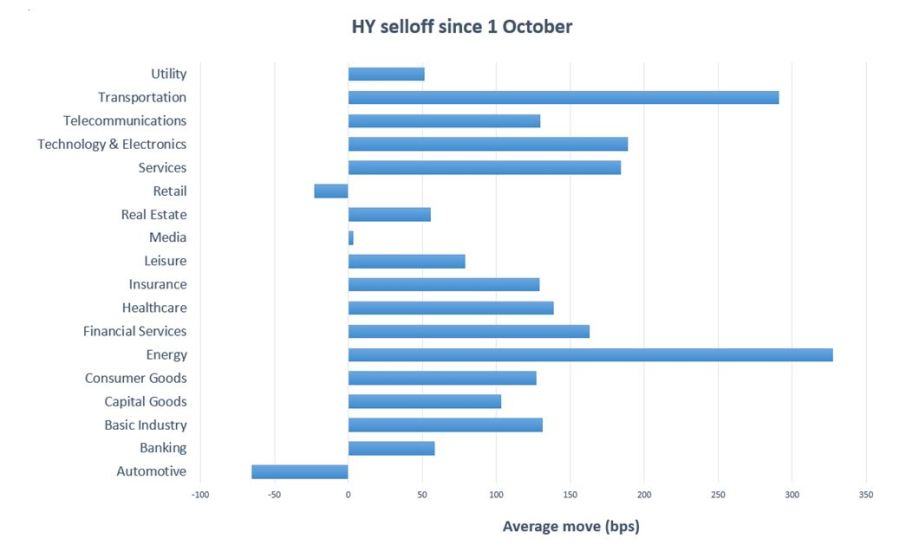
    Growing concerns that the next recession may come sooner than previously expected have pushed investors towards higher-rated names in less cyclical sectors. Investors broadly highlighted healthcare, telecoms and media as slightly lower risk sectors going into a downturn.

    “Industries that have recurring revenue streams such as certain segments in media, certain segments in telecom, and healthcare names will be fine,” said another portfolio manager.

    While markets fell this week after the Fed raised rates, higher-quality bellwether names in these sectors have substantially outperformed during the selloff.

    Centene’s Ba1/BB+ USD 1.2bn 4.75% senior unsecured notes due 2025 traded today at 95.25 to yield 5.687%, compared to 99.875 to yield 4.772% on 1 October, according to MarketAxess. That 91bps widening compares to an average widening of 139bps for healthcare names.

    T-Mobile’s Ba2/BB+ USD 2bn 6.5% senior unsecured notes due 2026 traded today at 103.035 to yield 5.798%, down from 105.625 to yield 5.207% on 1 October—a 59bps move, compared to an average widening of 130bps for the telecoms sector.

    On the other end of the spectrum, investors are deserting issuers that are seen as more at risk from an economic downturn, such as homebuilders and rental equipment.

    Homebuilder Tri Pointe’s Ba3/BB- USD 300m 5.25% senior notes due 2027 are trading at 80 to yield 8.6%, down from 90.125 and 6.77% on 1 October.

    United Rentals’ Ba3/BB USD 750m 4.625% senior unsecured notes due 2025 are at 88.25 to yield 6.8%, down from 97.57 for a 5.039% yield on 2 October.
    (Source: ICE BofAML HY Master index)

    Tariffs, man

    While global trade tensions—particularly between the US and China—have been on investors’ minds throughout 2018, the recent selloff has sharpened investors’ focus on how companies are adapting to tariffs and their impact on earnings, sources said.

    Issuers in the industrials, metals and mining and auto sectors have already been hit by higher raw material costs, putting pressure on their margins. A breakthrough in talks between China and the US earlier this month appeared to give some reprieve but the outlook is still uncertain.

    “A lot of these companies are already expecting troughs in their cycles in 2019 and then on the other end they’ll get squeezed by the increased costs for their material inputs, lowering their margins, if not eliminating them,” said one of the portfolio managers.

    AK Steel’s B3/B- USD 400m 7% senior notes due 2027 last traded at 82 to yield 10.284% on 11 December, trading down roughly 15 points from trades in the 97 context for a 7.443% yield at the beginning of October.

    Manufacturer Apex Tool Group’s Caa1/B- USD 325m 9% senior notes due 2023 traded at 88 to yield 12.799% on 13 December, down from 97.5 for a 9.71% yield at the beginning of October.

    Several automotive names have also declined, amid concerns over tariffs. Jaguar Land Rover’s Ba3/BB- USD 500m 4.5% senior notes due 2027 traded at 74 to yield 8.812% on 17 December, up from a low of 72.501 and 9.105% on 7 December but still down from 81.75 and 7.3% before the selloff.

    Auto parts manufacturer Tenneco’s B2/BB- USD 500m 5% senior unsecured notes due 2026 last traded on 14 December at 80.875 to yield 8.471%, down from 90.75 yielding 6.534% at the start of October.

    “We’re wary of the auto sector and companies supplying parts to GM and Ford,” said a portfolio manager. “Anybody susceptible to tariff issues that has raw materials sourced from China is going to hurt.”

    Over recent months, US auto dealers have also grown more pessimistic in their expectations for sales, according to data from the 4Q18 Cox Automotive Dealer Sentiment Index (CADSI), which surveys a sample of US auto dealers on current and expected auto retail sales.

    Dealer sentiment for the fourth quarter declined to 44 from 57 in 3Q18 and is expected to tick up only slightly in 1Q19 to 49, according to the CADSI.

    In a reflection of the risks of a recession as opposed to trade war pressures, the dealers attributed their deflated positivity to “rising interest rates and stretched consumer incomes,” according to a Cox Auto press release.
    Oil be damned

    Meanwhile, sources are divided over how to react to volatility in the energy sector, with some looking at the recent selloff as a buying opportunity and others treating it as a warning of more pain to come.

    WTI and Brent crude hit respective highs of USD 76.41 and USD 86.29 per barrel on 3 October, but have dropped to USD 46.24 and USD 54.89 over concerns around supply.

    Some investors see the drop in oil prices as temporary and expect a rebound in the latter half of 2019. “They just need to stick it out until then, and the higher quality names can do that,” said another portfolio manager.

    Others were inclined to stay away from the sector entirely. “It’s hard to not be invested given the size of the industry through the index, but it is becoming less and less attractive to us as an investable industry,” said a trader.

    Investors pointed to 3.7x-levered Chesapeake Energy and 5x-levered California Resources as examples of both ends of this spectrum.

    Chesapeake’s B3/B- USD 1.3bn 8% senior unsecured notes due 2027 traded at 85.5 to yield 10.638% this week, down 17 points from 102.623 to yield 7.492% on 1 October.

    California Resources’ Caa2/B- USD 2.25bn 8% second lien notes due 2022 last traded today at 66.188 to yield 20.944%, down from 97.345 to yield 8.764% at the beginning of October, according to MarketAxess.

  • [Editor’s note: This updates Debtwire’s Staples story from yesterday to add reporting in paragraph five on the company’s upcoming dividend plans.]

    Staples bonds ticked up after the company reported an EBITDA jump in its 3Q18 quarterly earnings report, according to two sources familiar with the matter.

    The Sycamore Partners-owned retailer’s USD 1bn 8.5% senior unsecured notes due 2025 traded up to 93.75 to yield 9.78%, up more than four points from 89.5 on 6 December, according to MarketAxess.

    EBITDA edged up 26% to USD 243m from USD 193m year-over-year, while sales increased 5% to USD 2.574bn from USD 2.453bn in the corresponding period, the sources said. The company is on track to book an estimated USD 929m of EBITDA for fiscal year 2018 ending 31 January, according to one of the sources.

    For 3Q18 ended 3 November, the company’s total debt balance stood at USD 4.064bn, the sources said. Based on roughly USD 854m of LTM EBITDA, Staples’ total leverage stands at 4.75x, while net leverage is around 4.3x net, the first source noted.

    Staples ended the last quarter with a cash balance of USD 393m, but some debtholders expect that position to take a drastic cut in fiscal 4Q18. Management disclosed on an earnings call today that the sponsor will take out a USD 250m-300m dividend and use proceeds to help fund the company’s upcoming acquisition of office solutions provider Essendant, the sources said. The company’s revolver had USD 175m drawn on it at quarter end.

    The capital structure was put in place to back Sycamore’s USD 6.9bn acquisition of the retailer’s commercial and delivery business in August 2017. The sponsor’s equity check amounted to 27% of the enterprise value. At the time of syndication, the LBO financing was being marketed at roughly USD 1.037bn in EBITDA, of which USD 237m consisted of pro forma cost savings.

    The company and Sycamore declined to comment.

  • Staples bonds ticked up after the company reported an EBITDA jump in its 3Q18 quarterly earnings report, according to two sources familiar with the matter.

    The Sycamore Partners-owned retailer’s USD 1bn 8.5% senior unsecured notes due 2025 traded up as high as 93.75 to yield 9.78% on Friday (7 December) after the earnings report, up more than 4 points from 89.5 on 6 December, before settling down to last trade today at 91.75 to yield 10.215%, according to MarketAxess.

    EBITDA edged up 26% to USD 243m from USD 193m year-over-year, while sales increased 5% to USD 2.574bn from USD 2.453bn in the corresponding period, the sources said. The company is on track to book an estimated USD 929m of EBITDA for fiscal year 2018 ending 31 January, according to one of the sources.

    For 3Q18 ended 3 November, the company’s total debt balance stood at USD 4.064bn, the sources said. Based on roughly USD 854m of LTM EBITDA, Staples’ total leverage stands at 4.75x, while net leverage is around 4.3x net, the first source noted.

    Staples ended the last quarter with a cash balance of USD 393m, but some debtholders expect that position to takes a drastic cut in fiscal 4Q18 on the back of an upcoming shareholder dividend, one of the sources said. The company’s revolver had USD 175m drawn on it at quarter end.

    The capital structure was put in place to back Sycamore’s USD 6.9bn acquisition of the retailer’s commercial and delivery business in August 2017. The sponsor’s equity check amounted to 27% of the enterprise value. At the time of syndication, the LBO financing was being marketed at roughly USD 1.037bn in EBITDA, of which USD 237m consisted of pro forma cost savings.

    The company and Sycamore declined to comment.

  • Broader weakness in the oil and gas sector has weighed on Indigo Natural Resources’ bonds over recent days, despite the company reporting a spike in revenue, EBITDAX and production for the third quarter, according to two sources familiar with the matter.

    Indigo’s USD 650m 6.875% senior unsecured notes due 2026 initially ticked up nearly a point on 8 November to trade at 96 for a 7.59% yield, after the company reported positive preliminary earnings for 3Q18.

    But the notes have dipped by three points since then, last trading on 29 November at 93 for a 8.177% yield, as investors have turned skittish on energy credits amid a plunge in oil prices and ahead of a crucial OPEC meeting this Thursday (6 November).

    Indigo issued the 6.875% notes in February to fund a strategic reorganization, combining Indigo Minerals, Indigo Resources and Indigo Haynesville to form Indigo Natural Resources, as reported by Debtwire.

    The deal was priced during a rally in oil prices that drove a resurgence of energy issuance in high yield. But oil prices have dropped nearly 20% since then, leading to an increasingly uncertain outlook for producers like Indigo.

    “[Indigo] issued this debt when the market was bullish on energy,” said one of the sources familiar with Indigo. “The tides have turned, so the company needs to keep production up to keep its bonds in the 90s. The OPEC meeting will determine what oil and gas names are going to do in the near term.”

    The Haynesville, Texas-based natural gas producer reported USD 367m of adjusted EBITDAX for the last nine months, up 120% year-over-year from USD 167m, the sources said. Based on previous Debtwire reporting, that takes LTM EBITDA to roughly USD 469m, leading to leverage of 2.5x based on USD 1.15bn of total debt.

    Adjusted EBITDAX for 3Q18 alone was USD 136m, up roughly 77% year-over-year from USD 77m, the sources added. Oil and gas revenue for the quarter totaled USD 214m, up 81% from USD 118m a year prior, according to the sources.

    Year-to-date production jumped to 704 MMcfe/day, an increase of 104% from 346 MMcfe/day.

    Natural gas was last quoted at USD 4.51, up 40% from the beginning of November and up 58% from February. WTI, on the other hand, was last quoted at USD 53.23, down 3% from the beginning of November at USD 63.69 and down 19% from February.

    As of 30 September, Indigo had USD 675m of liquidity with USD 85.3m of cash and USD 590m of availability on its credit facility borrowing base.

    Indigo declined to comment.

  • XOJET’s incoming sponsor, Rhone Capital, has upsized the equity contribution backing its buyout of the charter flight provider, after a more than a month of syndication weighed down by structural subordination concerns, said two sources following the deal. As such, lead arranger JPMorgan this morning unveiled revised terms including a downsized loan and wider pricing, said the sources and an additional source.

    Rhone is acquiring XOJET via its holding company Vista Global, which also owns premium global flight services provider VistaJet. For its part, the much larger VistaJet recently reported positive 3Q18 earnings featuring year-over-year growth in both revenue and EBITDA.

    JPM is now marketing a three-year USD 210m TLB for XOJET, down from a five-year USD 280m loan at its 18 October bank meeting. Price talk is Libor+ 575bps with a deeply discounted 91-93 OID, compared to L+ 475bps at 99.5 originally. Commitments are now due tomorrow (4 December) at 3pm ET.

    The structural changes bring leverage at the XOJET entity to 3.5x, compared to around 4.9x initially, given its roughly USD 57m in LTM EBITDA, sources said. XOJET has smaller scale compared to VistaJet, with the latter comprising about 85% of pro forma combined EBITDA, according to a 17 October Standard & Poor’s report.

    The XOJET financing is non-recourse to the other Vista Global businesses, according to Vista’s press release announcing the deal.

    Meanwhile, the XOJET term loan has a weak claim on collateral, despite its senior secured status, since all of the company’s aircrafts are first pledged to securitized aircraft financing debt, several of the sources pointed out. On a combined basis, XOJET and VistaJet will have USD 1.47bn in ABS debt, as reported.

    “In the event of a bankruptcy, the holders of aircraft debt would claim the assets, and then the loan would just recoup the equity in the company, which would be worthless,” one of the sources said.

    On the VistaJet side, VistaJet booked USD 173m in 3Q18 revenue, up 17.5% year-over-year, and USD 64m in EBITDA, up 6.7%, two additional sources said. VistaJet is levered at 7.2x based on USD 243m of LTM EBITDA and USD 1.74bn of total debt.

    VistaJet’s ‘B-’ rated USD 300m 7.75% unsecured notes due 2020 last traded in size on 19 November at 100.25 to yield 7.252%, down slightly from 100.875 on 30 October, according to MarketAxess.

    S&P analysts said in the 17 October report that they “expect VistaJet will continue to drive the group’s profitability assessment and support the business profile.” XOJET’s loan was initially rated B2/B, but the agencies haven’t weighed in yet post-downsizing.

    Vista Global and Rhone did not respond to requests for comment. JPMorgan declined comment.

  • Mood Media’s 3Q18 revenue fell by 11% year-over-year while EBITDA dropped only slightly, according to three sources familiar with the situation.

    The company booked USD 88m in revenue for the quarter, down from USD 98m for the corresponding period, driven by lower sales in all segments due to delayed execution on projects, two of the sources said. The EBITDA decline – USD 21m in the recent quarter from USD 21.6m in 3Q17 – was partly kept in check by cost-cutting measures to offset lack of organic growth.

    Mood’s new CFO hire announced this week will implement further cost cuts and synergies, one of the sources noted.

    “They were building projects around customers in global locations and they were expecting a couple to start in 3Q, but they didn’t, and so they will start in 4Q or 1Q19,” the first source said.

    Some investors were taken aback that that the company’s recent acquisition of Focus Four Media didn’t translate to revenue growth, the source continued. On a segment basis, Mood’s in-store media unit in North America generated USD 60.9m of revenues, down 3%, while its international in-store media unit generated USD 21.3m in revenues, down 17%, a source said.

    The consolidated results left the media company 6.3x levered, two of the sources said.

    Mood burned USD 17m of cash in the quarter, based on USD 7m of cash from operations less USD 24m of capex, according to the first source. As of 30 September, the company had USD 13.76m of liquidity, with USD 8.13m in cash and USD 5.63m of combined availability on its USD 15m revolver and USD 2.5m ABL facility.

    In a downgrade of the credit to CCC+ from July, S&P noted the borrower has an “unsustainable” capital structure with “limited ability to grow revenues and margins sufficiently to offset its elevated debt burden, which will likely continue to increase due to the accretion of PIK interest on its second-lien notes.”

    Still, the USD 207m 16.5% second lien PIK notes due 2024 are up around par, last changing hands in odd lots at 98.75 on 26 November, down slightly from its last trade in size at 99 on 5 July, according to MarketAxess. And two of the sources said the company could come to the market in 2019 to refinance the seconds.

    The borrower’s USD 288m Libor+725bps TLB due 2022 is quoted today in the 98.625/100.125 context, in line with recent levels, according to Markit.

    The company did not respond to request for comment.

  • The high yield market broke its fast for bond deals this week with Mercer International’s unsecured bond offering, which is getting more favorable buyside reception than the last crop of high yield deals following a turbulent month for markets, according to five sources following the transaction.

    Though Mercer operates in the volatile paper pulp sector, the bond deal backing its acquisition of peer pulp mill operator Daishowa-Marubeni International (DMI) should benefit from an expanded pro forma operating footprint and strong free cash flow as pulp prices ride a cyclical uptick, the sources continued.

    Led by Credit Suisse, the Canada-based borrower’s Ba3/BB- USD 350m senior unsecured bond marks the first new high yield offering for nearly two weeks, according to Debtwire data. Official price talk for the deal is in the 7.25% area as of Thursday morning, with books closing at 12.30pm ET, multiple sources said.

    Recent high yield issuers have struggled — Atlantica Yield pulled its unsecured notes offering last week, while Avation priced its add-on at a discount and HC2 was forced to restructure its deal multiple times, eventually pricing a convertible bond and a downsized senior secured note.

    Volatility has rocked markets over recent weeks, driving investor outflows from equities, high yield, and even leveraged loans. However, Fed chair Jay Powell’s comments in a speech Wednesday reassured investors over the pace of interest rate rises, sparking a rally.

    Solid credit

    Thanks to this more supportive backdrop and the fact that it is seen as a solid credit compared to most recent high yield issues, Mercer is expected to fare better.

    Along with cash on hand, Mercer plans to use the proceeds from the bond to finance its USD 359.2m acquisition of DMI. The acquisition, announced last month, is expected to close in 4Q18, pending regulatory approval.

    “It’s a good strategic acquisition, the credit metrics look strong, they have decent cash flow and the rating is up there, so they’ll be able to get it done,” one of the sources said.

    Pro forma the deal, the company is 2.4x levered, based on USD 453.93m of combined operating EBITDA and USD 1.089bn total debt.

    The rest of the company’s capital structure includes USD 100m 7.75% senior unsecured notes due 2022, USD 250m 6.5% senior unsecured notes due 2024, USD 300m 5.5% senior unsecured notes due 2026 and USD 30.73m in capital leases.

    Based on USD 454m of EBITDA, roughly USD 74m of interest expense, USD 126m of capex and USD 33m of dividends, free cash flow comes to roughly USD 221m, or 20% of total debt, according to deal documents. Accounting for USD 65m of tax provisions, that drops to USD 156m.

    Liquidity stands at USD 375.6m pro forma for the deal, with USD 220.2m of cash and USD 155.4m of revolver availability.

    Pulp (non)fiction

    Mercer’s business can be split into two segments: pulp (89% of pro forma LTM revenue) and wood products (11% of pro forma LTM revenue).

    The company expects the DMI acquisition to increase its annual production capacity for pulp by about 41% and surplus energy by about 8%, according to deal documents.

    The deal will also add northern bleached hardwood kraft (NBHK) pulp to Mercer’s product mix and expand the company into Asia. The company anticipates USD 15m-20m of synergies per year due to a greater number of mills, primarily within 12 months of closing the transaction, according to deal documents.

    Northern bleached softwood kraft pulp prices have been rising in recent years and should continue to drive topline and EBITDA growth for the company going forward, sources said. In 3Q18, the company’s pulp prices increased by roughly 34% to USD 852 per air-dried metric tonne (ADMT) from USD 638 per ADMT in the same period last year.

    One source ran a much more conservative cash flow model based on higher capex and lower EBITDA to account for declining pulp prices, but still came up with FCF of USD 70m-80m (roughly 7% total debt).

    Another source expressed concerns around cyclicality in the pulp and forest products space, but said Mercer was probably the best credit to own given those concerns.

    “There are not a lot of other credits in the space I would want to own given the cyclicality of the forest products and tissue markets,” he said. “Capacity for turning trees into pulp and paper tends to come on in chunks, usually at the top of the cycle.”

    At current price talk, the deal offers good compensation for concern around peak corporate earnings, one of the main drivers of the recent market volatility, one of the analysts said.

    Mercer’s own USD 300m 5.5% senior unsecured notes due 2026 traded on Wednesday at 94 to yield 6.566%, down four points from 98 in early October, when the acquisition was announced, according to MarketAxess.

    While the company has few direct comps, sources cited Brazilian pulp and paper company Fibria Celulose and Canadian packaging and tissue product company Cascades.

    Fibria’s Ba1/BBB- USD 600m 4% senior unsecured notes due 2025 last traded on 2 November at 94.5 to yield 5.045%, according to MarketAxess. Cascade’s Ba3/BB- USD 200m 5.75% senior unsecured notes due 2023 traded yesterday (28 November) at 98 to yield 6.253%.

    Mercer did not respond to request for comment. CS declined to comment.

  • Anchor Glass Container’s 3Q18 EBITDA fell 19% year-over-year as revenue declined by 9%, said three sources familiar with the matter. The company is still feeling the residual effects from 2Q18 headwinds, especially the loss of volume from one its major customers, Dr Pepper Snapple Group, two of the sources said.

    The volatility has spread into the CVC Capital Partners-owned company’s loans. Anchor’s USD 647m Libor+ 275bps (1% floor) TLB due 2023 is quoted in the 87.25/88.5 context today, down from 88.806/90.083 on 14 November, according to Markit. Its USD 150m L+ 775bps (1% floor) second lien TL due 2024 moved down a touch to 65.143/69.143 from 65.429/69.286 before the earnings, but up from the 62.25/65.375 context after the company reported 2Q18 earnings.

    Management said on its recent 3Q18 earnings call that it expects to partially recover the lost capacity that was previously designated for Snapple, which has been packaging more of its drinks in plastic. The guidance for only a partial recovery from Snapple losses marked a shift from previous management comments that the company will recapture 100% of lost volume, two sources said.

    Anchor reported USD 29m of EBITDA for 3Q18, down 19% from USD 36m booked in the prior-year period, primarily driven by lower volumes and lower revenue, the sources said. The company generated USD 142m of revenue, down 9% from USD 156m, two of the sources said.

    Volumes fell 13% to 250 tons shipped from 287 tons shipped in 3Q17. That weakness was partially offset by an increase in prices, two of the sources said.

    “The price has been up in the past quarters, but volumes keep going down, and there is a limit of how much price can go up,” the second source said.

    Volumes in the quarter were also affected by the fire at one of the plants in May. The plant is now 80% operational, according to one of the sources.

    Anchor Glass gave capex guidance for fiscal year 2018 at USD 55m – USD 65m, up from an expected roughly USD 50m of capex, a source said. A portion of the increased capex is expected to be financed by insurance proceeds from the fire and other incidents.

    The company also expects for fiscal year 2019 capex guidance to be higher, including the expenses to make its equipment more environmentally friendly in compliance with the EPA settlement.

    Liquidity as of 30 September stands at USD 127m with USD 7m in cash and an undrawn USD 120m ABL due 2021, according to two of the sources.

    Based on USD 117.4m of LTM EBITDA and USD 789m of total debt, the company is levered 6.7x, the first source said. Excluding a USD 11.4m EBITDA addback for closed capacity, the company is levered 7.4x.

    The company generated roughly USD 13m of free cash flow on an LTM basis, based on USD 106m of EBITDA, USD 44m of capex and USD 49m of interest expense, one of the sources said.

    Anchor Glass did not respond to a request for comment. CVC declined to comment.