• Atotech’s new USD 300m 8.75%/9% notes mark the first holdco PIK toggle dividend deal issued this year in the US high yield market, according to Debtwire data.

    The chemical company’s sponsor, The Carlyle Group, is recouping nearly half of its original equity contribution with proceeds from the bonds and a USD 200m add-on term loan – but sources note the January 2017 LBO was arguably over-equitized to begin with.

    “Carlyle put in 40% equity, at a time when most PE funds were putting in 25%-30%,” said a buysider. “They’re probably one of the better sponsors; at least they have a better track record in this space. Obviously a dividend deal is never the best, but I don’t think it’s egregious here.”

    Before Atotech’s CCC+/Caa1 deal, which priced yesterday, the last PIK toggle dividend deal to clear the market was Polaris Intermediate Corp (aka MultiPlan) in November 2017. That deal, a B-/Caa2 USD 1.3bn 8.5%/9.25% note due 2022, last traded 23 May at 103.75 to yield 7.096%.

    Only two other holdco dividend deals priced in all of 2017 – Eagle Holdings’ USD 550m 7.625%/8.375% senior PIK toggle notes due 2022 in May and Vertiv’s USD 500m 12%/13% senior PIK toggle notes due 2022 in February, Debtwire data show. The Eagle Holdings notes traded yesterday at 101.25 to yield 6.93%, but Vertiv’s bonds haven’t held up as well, last trading Tuesday (22 May) at 95.75 to yield 13.471%.

    Platinum Equity-owned Vertiv is somewhat emblematic of the risk of buying into holdco notes, as the notes bore the brunt of selling pressure after it just last week reported a year-over-year EBITDA decline for 1Q18, said one of the sources. The data center equipment provider’s 12% toggle notes fell as low as 92.5 to yield 14.662% last week, from trades around par previously, according to MarketAxess. Meanwhile, its opco USD 750m 9.25% unsecured notes due 2024 last traded at 98.25 yielding 9.62% compared to par earlier this month and a 94.5 low on 17 May, and quotes on its USD 2bn Libor+ 400bps TLB due 2023 have sagged by less than a point to the 98.8/99.45 context, according to Markit.

    In Europe, PIK toggle dividend deals have been similarly rare over the last year. Kleopatra Holdings 1 (aka Klockner Pentaplast) came in July 2017 with EUR 395m 8.5%/9.25% senior PIK toggle notes due 2023 and Horizon Parent Holdings priced EUR 350m 8.25%/9% senior secured PIK toggle notes due 2022 in May 2017. Meanwhile, a PIK for life deal from Ardagh for USD 350m notes due 2023 was issued out of newly formed subsidiary ARD Securities Finance in January 2018.

    For Atotech, lead bookrunner JPMorgan launched the five-year bonds on Monday (21 May), and priced them yesterday in line with talk, at a 99.01 OID to yield 9%.

    Back where it started

    Investors piled into the deal, nudged along by promise of yieldy paper. The 9% all-in pricing offers a 250bps premium over Atotech’s existing USD 425m 6.25% senior unsecured notes due 2025 that sit at the opco, for less than a turn of additional leverage.

    The opco notes last traded in size at 101.7 yielding 5.73% on 10 May, according to MarketAxess. More recently, after the dividend deal was announced, the bonds were quoted around 99 for a 6.434% yield, said a trader.

    The new PIK toggles traded this morning at 100.625 yielding 8.51%. In comparison, the average yield of all high yield deals at issuance so far during 2Q18 is 6.99%. The average for all chemical deals over the same period is 7.29%, according to Debtwire data.

    “Nothing in chemicals is that high,” said one buysider, referencing the relative attractiveness of the economics of taking on the holdco risk.

    The Atotech holdco paper offers a buying opportunity for some who like the credit but passed on the opco notes last year. “Pricing was too tight [on the opco notes] so I ended up passing,” one of the sources said.

    Indeed, other recently issued deals with high single-digit or low double-digit yields were largely for more problematic credits, like Titlemax’s USD 450m senior notes due 2023, which priced at 11.125% and par, and JW Aluminum’s USD 285m senior secured notes due 2026, which priced at 10.25% and par. Consumer finance provider Titlemax faces perennial regulatory pressures while JW is closely tied to commodity prices that brought on a restructuring just a few years ago.

    So far Atotech has a successful LBO story to tell. Carlyle bought the company from Total SA for USD 2.7bn, contributing USD 1.2bn in equity, or 44% of the deal’s enterprise value. The LBO was backed by the 6.25% bonds as well as a USD 1.4bn in term loans, with leverage at the time around 6.8x given USD 274m in 2016 adjusted EBITDA.

    Now, leverage has declined to the 5x area thanks to an increase in adjusted EBITDA to USD 355m. The USD 500m in additional debt to back the dividend will bring total debt to USD 2.4bn and send leverage back up to 6.8x – or right around its initial LBO level, sources said. Looking ahead, Carlyle still has around USD 700m of skin in the game, sources noted.

    Both Standard & Poor’s and Moody’s note that Atotech has a leading position in electronics plating and should generate free cash flow in the year ahead. Moody’s projects EBITDA growth in the near term and estimates the company will throw off USD 90m-USD 95m in free cash flow annually over the next two years.

    Pro forma the deal, liquidity is USD 561m, including USD 250m of availability out of a USD 277.5m revolver and USD 311m of cash.

    Carlyle and JP Morgan declined to comment. Atotech and Vertiv did not respond to requests for comment.
  • JW Aluminum is struggling to get investors interested in its new USD 285m secured notes offering at the single-digit pricing that it’s been angling for since it withdrew a similar deal back in February, said seven buysiders and a trader following the deal. The company needs the proceeds for a crucial revitalization project that’s already underway.

    As such, the flat-rolled aluminum products producer now finds itself somewhat at the mercy of buyside pricing demands, since the optics of pulling another deal from syndication and having to return a third time to raise the funds could be especially problematic. At the heart of some investor qualms about the bonds is JW’s dependence on commodity prices – which led it into a debt restructuring less than three years ago, sources said.

    “They’re dependent on Midwest Aluminum Premium, which can collapse – and the best example of this is their last restructuring,” one of the buysiders said. The price of aluminum on the London Metal Exchange bottomed out in November of 2015 at USD 1,425.5 per metric ton, compared to USD 2,082 a year earlier. It has since recovered to trade at USD 2,303 per metric ton yesterday (17 May).

    Still, this time around JW has an improved credit profile versus when it came to market during 1Q, thanks to EBITDA improvement and an increased capital contribution from its sponsors.

    The company’s principal shareholders now include Goldman Sachs, FS/KKR Advisor, Pentwater, and Magnetar, after its November 2015 restructuring deal cut USD 135m in debt from its balance sheet, according to a source familiar with the company

    Goldman Sachs also serves as lead bookrunner, and launched the B-/B3 rated eight-year USD 285m senior secured notes on Tuesday (15 May) with plans to wrap the roadshow yesterday (17 May). Price whispers have been a moving target in recent days, circulating in the high 9% to 10% area, sources said.

    However, many buyside accounts expressed interest initially if the yield would have come in the double-digits, said five sources.

    “Goldman said they recognize they tried to bring this deal before for an eight-handle and it didn’t work,” a buysider said, adding that this time around the company “might have to swallow a coupon of 10% or higher.”

    Marketing of the bonds will extend into next week, as Goldman hasn’t yet set official talk.

    Proceeds from proposed bonds are to fund Project Boilermaker, a modernization project for its largest plant in Mount Holly, South Carolina, and to pay down a USD 151m term loan due 2023. A sponsor contribution of USD 50m, up from USD 35m planned when it first unveiled the bond deal in January, completes the pro forma funding needs. This contribution is in addition to a USD 35m capital contribution from the sponsors in late February.

    “It makes sense that the bondholders would want the sponsors to inject more equity into the deal since that would make them junior to the bondholders. But the more important thing is aluminum. The price of aluminum has been all over the place, and investors obviously don’t want to buy into a deal that’s not going do well,” said a buysider.

    JW originally brought a slightly larger USD 300m deal to market in January, and pulled it on 6 February amid a sharp selloff in equities, citing adverse market conditions, a source said. By that time, price whispers had climbed to the 10% area.

    “Yes, the market fell, but only after they roadshowed for a week,” a buysider said. “They just didn’t want to pay that high of a coupon.”

    Pro forma leverage is around 5.8x, based on USD 47.2m in LTM adjusted EBITDA at 31 March and USD 275m total debt, according to a source familiar with the matter, up from 4x before the deal based on USD 189m of total debt. In comparison, when JW announced the deal in January, pro forma leverage would have been 7.4x, based on USD 288.611m of total debt and USD 39.096m LTM adjusted EBITDA.

    The Project Boilermaker plan will increase annual production capacity to 408m pounds, up from 230m pounds, according to a source familiar with the matter, by updating the plant’s equipment. Construction began in February 2018, with full production and sales operations projected to begin by February 2022.

    The total estimated cost of the project rose to USD 269.5m from USD 255m, when the initial deal was announced in January. The increase is due to a jump in the estimated cost of Phase I to USD 198.5m from USD 185m.

    “I would argue they’re doing a better project,” said a buysider. “Everyone else is just rolling, existing, trying to get a better rate, but they’re doing material improvements.”

    The deal would offer a significant premium over the bonds of fellow high yield rolled aluminum makers Aleris and Novelis. Aleris’s CCC+/Caa2 rated USD 440m 7.875% senior unsecured bond due 2020 last traded yesterday (17 May) at 98.5 to yield 8.564%, while Novelis’s B2/B USD 1.5bn 5.875% senior unsecured notes due 2026 last traded today at 99.375 to yield 5.972%, according to MarketAxess.

    “JW Aluminum is definitely going to price wider than Novelis. Novelis is much bigger and most of their revenue comes from beverage cans, which as an industry does not face much volatility, whereas JW’s business includes more industrial end market and packaging products,” said one buysider. “Aleris, like JW, includes some industrial end market products, but they’re more diversified than JW.”

    Moody’s estimates that JW will burn cash through 2020, and that it could return to positive free cash flow in 2021. Pro forma the deal, the company will have USD 134m cash and an undrawn USD 90m revolver.

    Goldman Sachs and JW Aluminum declined to comment.

  • Hexion’s second lien bonds traded up around three points today after the chemical maker reported 1Q18 results showcasing higher sales and segment EBITDA. However, on this morning’s call, management was mum on the progress of its asset sale efforts – which are critical for a successful refinancing of the junior debt.

    CEO Craig Rogerson stressed that a “normal timeline” is underway and that the process is “where we expected, everything is moving ahead as planned.” The comments came after several call participants pushed for more details.

    “Clearly, deleveraging is a consideration…We’re looking at the maturities we have in 2020 and looking at this as a way to effectively deal with that, while having a company at the end of the day that makes a lot of sense, that’s got growth potential and that’s worth continued investment,” said Rogerson when asked about the big-picture goals for the strategic process.

    “The quarter showed growth, but they have more than USD 1bn in debt due 2020, and the asset sale was the one thing that [management] didn’t really address on the call,” said a buysider in an interview following the earnings call.

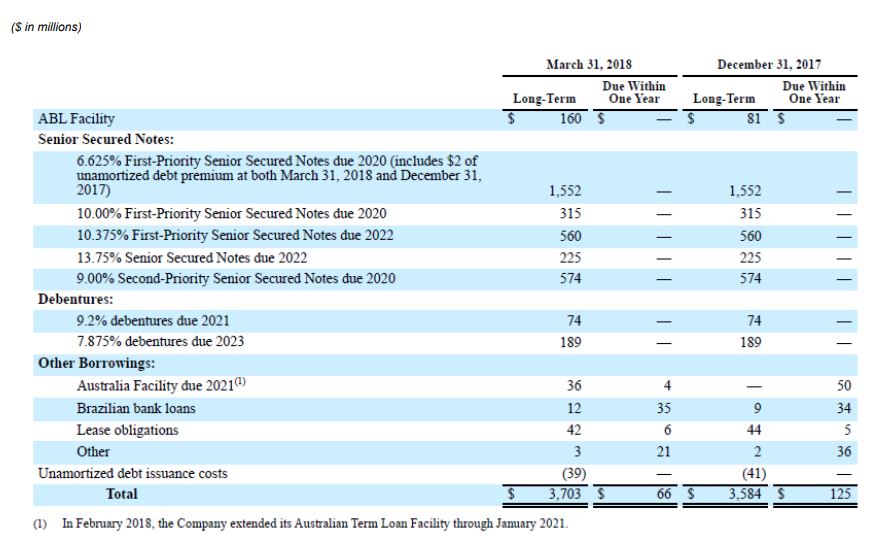
    After the call, Hexion’s USD 1.55bn 6.625% first lien notes due April 2020 traded about a half-point higher to 95.75, yielding 9.1%, while its USD 315m 10% first lien notes due 2020 rose about a point to 101.125 yielding 8.676%, according to MarketAxess. The USD 574m 9% second-priority senior secured notes due 2020 jumped three points to 85 to yield 16.6%, and the USD 225m 13.75% 1.5-lien notes due 2022 traded up to 89 yielding 17.9% from trades around 86.5 last week.

    Management stated that EBITDA benefitted from significant improvements in its base epoxy resins and phenolic specialty resins businesses, as well as the positive impact of cost reduction initiatives. Hexion’s formaldehyde and forest product resins business also positively contributed to the quarter’s results. For FY18, Hexion expects improved segment EBITDA as compared to FY17.

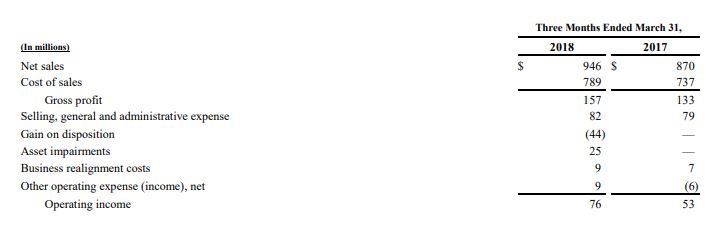
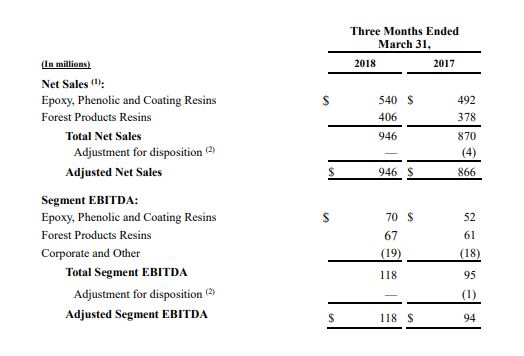
    The company’s net sales rose 8.7% year-over-year to USD 946m in 1Q18, compared to USD 870m in 1Q17. Excluding net sales of approximately USD 4m related to asset sales in the Forest Products Resins business, 1Q18 net sale rose 9.2%. The increase was driven by pricing initiatives in the base epoxy resins business, and the pass-through of higher raw material costs in the global forest products resins and phenolic specialty resins businesses.

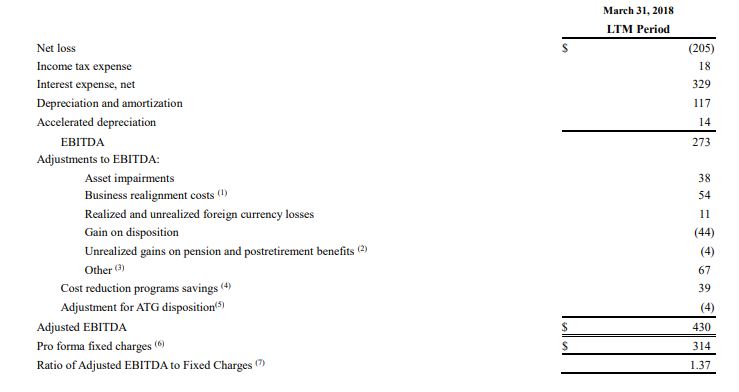
    Hexion reported USD 118m (12.5% margin) of segment EBITDA for 1Q18, a 24.2% YoY increase from USD 95m (10.9% margin) in 1Q18, but rose 25.5% when adjusted for divestitures. The improved results reflected cost reductions, and higher margins in the base epoxy resins, phenolic specialty resins, and global forest product resins and formaldehyde businesses. Adjusted segment EBITDA, for the trailing twelve months was reported at USD 430m.

    By segment, net sales for Epoxy, Phenolic and Coating Resins in 1Q18 increased by USD 48m, or 9.8% YoY, to USD 540m from USD 492m in 1Q17, due to the pass through of higher raw material costs and price actions in certain businesses, partially offset by a decline in volume. By numbers, the sales increase was the result of YoY change in price/mix (+7%) and currency translation (+8%), offset by volume (-5%).

    Segment EBITDA rose USD 18m, or 34.6% YoY, to USD 70m for a 13% margin, which marked a 240bps increase from a segment EBITDA margin of 10.6% in 1Q17. Segment EBITDA benefited from a significant increase in base epoxy resins, driven by strong market fundamentals, YoY improvement in phenolic specialty resins due to the company’s diversified portfolio and recent cost actions. Management stated that there was continued strong volume in the NextGen EpoxyTM Waterborne System. Hexion Management expects the company’s base epoxy business to continue showing strong volumes in 2018 with high prices. Also, Hexion’s waterborne coatings business will become an increasingly significant contributor to its overall specialty epoxy growth in 2018 and 2019.

    Forest Products Resins’ net sales increased by USD 28m, or 7.4% YoY, to USD 406m from USD 378m in 1Q17, due to price mix (+7% YoY) and currency translation (+2%), partially offset by weaker volumes (-1% YoY), and the impact of dispositions (-1%). Revenue increased in all geographic areas, and reflected the contractual pass-through of higher raw material costs partially offset by slightly lower volumes due to weather-related customer shutdowns.

    Segment EBITDA increased USD 6m, or 9.8% YoY, to USD 67m (16.5% margin) from USD 61m (16.1% margin), reflecting volume gains in Latin America and Europe, partially offset by weather-related weakness in North America. Segment EBITDA also benefitted from cost efficiencies from the new North America formaldehyde facilities.

    Hexion had cash usage from operations of USD 83m during 1Q18, compared with net cash usage of USD 118m in 1Q17. With net proceeds from asset sales of USD 50m, and capital expenditures of USD 25m during the quarter, net cash provided from investing activities was USD 25m compared with net cash used in investing activities during 1Q17 of USD 26m.

    During 1Q18, Hexion achieved USD 13m of cost savings, and has identified approximately USD 40m of savings related to headcount reductions. At 31 March 2018, the company had USD 39m of annualized in-process cost savings that it expects to realize the full run-rate by 2018 year-end.

    Management commented that it expects further structural cost savings in 2018, and for continued growth across most product lines to support 2018 segment EBITDA growth.

    Analyst Snapshot: Key Points
    Seth Crystall, Senior Analyst, 646-378-3105

    • In January, Hexion announced the sale of its ATG business for approximately USD 49m in proceeds, with the net funds for use in general corporate purposes. The business was sold at a multiple of 12 times LTM EBITDA. Management previously estimated that this business accounted for 2017 sales and EBITDA of USD 40m and USD 4m, respectively.
    • The company has initiated a process for the sale of a portion of its Epoxy, Phenolic and Resins segment. Hexion is pursuing this sale as it represents an attractive opportunity to monetize assets, simplify its portfolio and materially reduce its debt, especially the need to address its 2020 maturities.
    • Hexion stated that it expects epoxy resins supply/demand dynamics to remain favorable for the foreseeable future, supporting continued profitability. There are no significant known planned capacity additions.
    • Management believes that its Forest Products segment will benefit from an ongoing recovery in housing starts driving growth in North American resins, and demand for sustainable product solutions. The company believes that the annual segment EBITDA can eventually hit USD30m-USD35m, but is currently running around USD 20m.
    • Hexion’s wind energy business in China is stabilizing, as lower demand and pricing pressure hurt it. The company believes that this business will recover, but doesn’t expect to see much change in 2018.
    • The company does not expect as quick of a recovery in establish drilling basins for its coated proppants business, as the current cost compared to sand would be 3x-4x the cost of sand.
    • The average prices of Hexion’s major raw material inputs of methanol and urea increased 10% and 3%, respectively, while the price of phenol fell 3% for 1Q18 versus 1Q17. Global raw material pricing increased approximately 9% sequentially in 1Q18 from 4Q17.
    • Capital expenditures for 1Q18 were USD 25m versus USD 30m in 1Q17. Management is estimating a 2018 capex of USD 80m-USD 90m.
    • Hexion continues its focus on managing its working capital. Management expects working capital to increase modestly in FY18 compared to FY17 with an increase in 1H18 and a decrease in 2H18. The increase in FY18 working capital includes the company’s 1Q18 asset sale.
    • The company had USD 282m of liquidity at 1Q18-end, comprising of USD 95m of unrestricted cash, USD 145m of availability under its USD 350m senior secured asset-based revolving credit facility and USD 42m available under international credit facilities.
    • Hexion had USD 3.8bn of total debt at 31 March, compared to USD 3.7bn at 2017-end. We calculated total leverage of 8.7x based on LTM adjusted EBITDA of USD 430m, with a leverage of 8.0x through the company’s second lien notes.
    • The company reported that its adjusted EBITDA-to-fixed charges ratio was 1.37x compared to a secured notes covenant minimum ratio of 2x, which would restrict Hexion from incurring additional indebtedness and making investments. There are exceptions to these restrictions, however, permitted under the ABL facility, which provides USD 145m of availability for borrowing.

    Analyst Takeaway –With its 2020 maturity wall on the horizon, management will need to address it at some point in time, but for the moment, it would appear that HXN has some runway to stabilize its business, benefit from improvements in its businesses and make asset sales to pay down debt.

  • Hexion’s ability to shimmy through a USD 2.44bn maturity wall in 2020 will depend on achieving both high-multiple asset sales and an elusive turnaround of its underlying operations, according to five buyside analysts tracking the company.

    And as the nearly 10x-levered diversified chemical producer prepares to report 1Q18 earnings on Monday, investors are looking for any details regarding potentially delevering asset sales, and will be watching for signals about refinancing prospects embedded in the company’s earnings performance, the sources continued.

    Judging by trading levels for Hexion’s USD 574m 9% second lien notes due in 2020, the market is not baking in an undeniable refinancing. The notes changed hands yesterday at 82 to yield 18.28%, according to MarketAxess.

    For their part, the company’s first lien bonds due in 2020 – a USD 1.55bn 6.625% note and a USD 315m 10% note – trade closer to par, at prices of 95 and 100.375 and yields of 9.535% and 9.552%, respectively.

    But the borrower still has some levers to pull, namely in the form of prospective asset sales that will need to be executed at double digit multiples and whose proceeds will likely be allocated to paydowns of first and second lien debt, the sources said.

    “It’s hard to have a lot of conviction with specific scenarios because it’s an Apollo company,” said one of the analysts. “But I think they’ll try to sell some of the businesses on forward-looking, improved performance and chip away at the 2020 maturities.”

    “And then they’ll grow EBITDA at the remaining businesses as a bridge to a refi,” the source added.

    Multiple plans

    Hexion in February engaged Credit Suisse and Barclays to review strategic alternatives, including a sale of a portion or all of the business. In filings, the company said it initiated a process to specifically sell a portion of its epoxy, phenolic and coatings resins segment. And investors have zeroed in on both Hexion’s phenolics as well as its Versatic and forest products businesses as the most likely sale candidates, the sources said.

    As an example, the Versatic Acids business – which adds adhesion and stability properties to finished coatings – generates approximately USD 60m of EBITDA, and could fetch a multiple in the low double digits, bringing in at least USD 600m of proceeds, two of the analysts said.

    Investors were encouraged by the roughly 12x multiple garnered by Hexion when it sold its ATG business in January, taking it as a sign it could achieve similar multiples on other, possibly larger portions of the epoxy, phenolic, and coatings segment, the sources said.

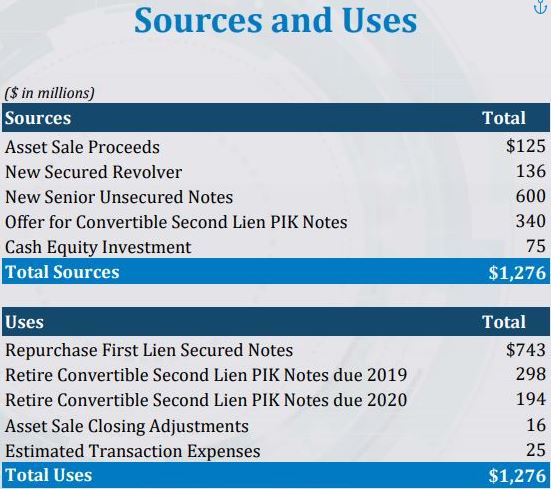
    Divestiture proceeds could pay down first lien debt, which makes up a larger portion of the 2020 maturities. But proceeds could be used more effectively to buy back the 9% second lien notes at a discount, two of the analysts said. Hexion, as such, could contemplate using investment baskets to more aggressively address the second lien maturity. For example, the company could consider using an unrestricted subsidiary as an intermediary entity to potentially circumvent first lien prepayment requirements, they added.

    In many ways, the refi playbook follows a plan executed previously by Hexion. Leading up to a 2018 maturity wall, the borrower used cash and asset sales to cut maturities down to a manageable size by repurchasing bonds at a discount, and then launched a successful – but expensive – refinancing.

    Ripping epoxies

    A maker of an array of chemicals for everything from wind turbines to construction materials, Hexion groups its business into two segments: forest product resins and epoxy, phenolic and coating resins. Its earnings performance has sagged along at trough levels for years, pinned down by epoxy oversupply, the collapsing oil market, and only a slow recovery in U.S. home construction.

    Nevertheless, favorable macro trends stemming from Chinese demand for waterborne coatings combined with the uptick in oil prices and new housing starts in the U.S. are expected to provide a boost to Hexion earnings in 2018, the sources said.

    It might be just in time.

    “Epoxy prices are ripping,” said one of the analysts, referencing double-digit increases depending on the geography for the polymer, used in cars, pipelines, and metal packaging, among other things.

    On its earnings call last week, management from Hexion competitor Olin said that liquid epoxy prices increased 21% and 27% in North America and Europe during 1Q18, respectively, followed by an additional bump in April.

    Hexion’s base epoxy in intermediates generated USD 107m in EBITDA in 2011, but fell to USD 7m in 2016. Asked on the 4Q17 call whether that 2011 figure is attainable again, CEO Craig Rogerson responded affirmatively, saying they would pass the mid-point to USD 107m during 2018.

    Increased housing starts in the US, though below the 40-year average of approximately 1.5m annual starts, “should provide an additional tailwind for us from the operating leverage created by incremental volumes and our ongoing productivity actions,” Rogerson said, with regard to Hexion’s forest products business.

    On an LTM basis, Hexion generated USD 424m of adjusted EBITDA. However, roughly USD 182m of that consists of adjustments for restructuring costs and projected savings, leading some investors to give them credit for only roughly USD 370m of EBITDA, the sources said. That pushes leverage to 10x.

    Nevertheless, on a consolidated basis, and given the advantageous macroeconomic backdrop, Hexion EBITDA could climb closer to a range of USD 425m – USD 450m in 2018, the sources said, leaving it levered between 8.2x – 8.7x.

    For comparison, industry comps Olin and Huntsman trade at equity multiples slightly lower than Hexion’s total leverage. Olin’s current EV multiple is 8.5x, whereas Huntsman’s current EV multiple is 7.7x, for instance.

    “Huntsman has the best business because it is the least commoditized, and Olin has the most exposure to commodity prices, so Hexion is somewhere in the middle,” said a third buysider.

    “Chemical multiples are high,” said the fourth analyst. “It might not be as complicated as everyone thinks.”

    Hexion did not respond to a request for comment. Apollo declined to comment.

  • California Resources (CRC) bonds moved up today after the exploration and production company surprised investors by reporting positive adjusted net income and handily beating analyst expectations, said a trader and a buysider.

    “The company beat expectations by a long shot,” said a trader.

    CRC’s CCC+/Caa2 rated USD 2.25bn 8% second lien secured notes due 2022 jumped nearly four points to trade at 89 yielding 11.112%, from 85.375 and 11.263% before the earnings, which came out after market close yesterday. The company’s stock traded today at USD 31.95 for a market cap of USD 1.441bn, up 23.58% from yesterday’s close.

    The company’s 1Q EPS of USD 18 cents per share substantially beat consensus analyst expectations of negative USD 75-83 cents. Quarterly revenue increased 3.2% year-over-year to USD 609m, while adjusted EBITDAX rocketed 61% YoY to USD 250m.

    “They have sequential production increases, which I think is often overlooked in the narrative,” said the buysider, adding that he expects CRC to continue de-levering.

    “They did not get killed by their hedges, unlike some other smaller E&P companies,” the trader said. CRC’s realized crude prices, including the effect of settled hedges, increased by 25% per barrel during the quarter, to USD 62.77, versus 1Q17.

    The company in February repaid USD 297m of revolver borrowings, and then made several repurchases of its second lien notes at a discount, paying USD 79m for USD 95m in principal, according to CFO Mark Smith on the earnings call yesterday.

    The company will continue to be opportunistic about further buybacks, he added. CEO Todd Stevens reiterated that the company aims to de-lever by both reducing debt and continuing to increase earnings.

    CRC generated USD 61m in free cash flow during the quarter.

    The company also completed an acquisition of Chevron’s assets in the Elk Hills field of San Joaquin, California, in April with USD 460m cash and 2.85m CRC common shares. The acquisition is expected to bring USD 5m of operational savings and USD 15m of additional synergies annually and to be fully operational by the second half of 2018.

    CRC has been active in liability management and the monetization of assets. It entered a joint venture with Ares Management in February, in which Ares invested USD 750m. Late last year, the company raised a new USD 1bn term loan and obtained a credit facility amendment providing covenant relief.

  • Centene is gearing up to come to market in the coming weeks with the USD 1.6bn bond deal backing its acquisition of Fidelis, said five sources following the deal. The deal was expected to launch earlier this week, but lead underwriter Citigroup pushed out the timeline, and the deal is now expected to come as early as next week, the sources said.

    Somewhat choppy trading in Centene’s outstanding debt suggest the health insurance provider’s bonds may require a wider yield than they would have if the deal had come a few weeks ago, two of the sources noted.

    Centene’s existing unsecured notes, which will remain outstanding pro forma the buyout financing, rallied in April but then sold off.

    Its USD 1.2bn 4.75% bonds due 2025 gained nearly three points in April to trade at 100.25 and 4.689% but have since sold off to trade at 97.625, yielding 5.173%, according to MarketAxess.

    The bonds have traded down from 104 and 3.911% in September 2017, when Centene announced that it would purchase fellow insurance provider Fidelis for USD 3.75bn, and that it would finance the deal with a USD 2.6bn equity offering alongside the USD 1.6bn bond placement.

    The deal was slated to close by 1 April, and the company had indicated plans to syndicate the debt during the first quarter, according to one of the sources.

    But last week the company officially extended the close date to 1 July, citing regulatory approval conditions in New York state.

    The equity offering priced on Monday at USD 107.50 per share, and has gained 7.04% to close at USD 115.07 today. Shares were trading at around USD 98 the day after the deal announcement in September.

    The merger is likely to be roughly leverage-neutral for Centene this year, estimated an analyst following the company. Leverage is currently around 2.6x and will likely settle around 2.8x by the end of 2018, and decline further thanks to earnings growth in the year after, he said.

    Centene will likely face pricing expectations in the mid to high-5% area, given the yield on its existing bonds – currently rated BB+/Ba1 – and those of several comps, sources said.

    Bellwether healthcare issuer HCA’s B+/Ba2 ratings USD 1.5bn 5.875% senior unsecured bond due 2026 last traded today at 101.5 to yield 5.619%.

    “Centene might come in a bit tight of [HCA], maybe 5.375%, since Centene is higher rated than HCA,” said one buysider.

    Medicaid service provider Wellcare’s BB/Ba2 ratings USD 1.2bn 5.25% senior unsecured bond due 2025 last traded on Wednesday (2 May) at 101.125 to yield 4.988%.

    Centene’s bonds have widened out by 100bps-140bps since the Fidelis deal was announced in September.

    “From when they announced, I’d say they’re going to have to pay 50bps more, and 50bps on USD 1.6bn is not nothing,” said one buysider.

    CEO Jeffrey Schwaneke acknowledged as much on the company’s 24 April earnings call, but noted that the equity dynamics have improved. “Bond rates have moved against us, share price has moved in our favor,” he said.

    Centene has a managed care segment that provides insurance coverage to individuals through government-subsidized programs like Medicaid, and a specialty services division that offers healthcare services and products to both state and commercial organizations.

  • Consolidated Energy’s new USD 1.075bn in financing will clear away near-term maturities and set the stage for de-levering, thanks to recovering methanol prices and the company’s new facility in Texas, according to four buysiders following the deal.

    The methanol producer is in the market with a dual-tranche USD 525m bond along with a USD 550m TLB due 2025, proceeds of which will collectively refinance its remaining USD 496m 6.75% notes due 2019, as well as a USD 272m term loan and a revolver with USD 260m outstanding at subsidiary Methanol Holdings Limited (MHTL).

    Lead bookrunner Morgan Stanley outlined price talk on the bonds this afternoon and simultaneously carved out a shorter-dated USD 100m floating-rate tranche. The now-USD 425m eight-year fixed paper is guided at 6.25%-6.5%, in line with whispers that circulated earlier this week, the sources said. The USD 100m four-year floating-rate tranche due 2022 is guided at Libor+ 375bps (0% floor) at par. The roadshow kicked off on Monday (30 April).

    Talk on the 2026 notes offers a premium to Consolidated’s existing USD 500m 6.875% unsecured notes due 2025, which traded today at 104.125 to yield 5.927%, according to MarketAxess. The notes widened slightly since the financing plan was unveiled several weeks ago, having traded at 105 yielding 5.74% on 12 April. Consolidated just placed the 2025s last May, also to refinance debt.

    The USD 550m TLB, also led by Morgan Stanley, was guided at L+ 250bps-275bps (0% floor) with a 99.5 OID. Commitments were due today.

    The refinancing is leverage neutral, at around 7.38x, given USD 2.4bn in total debt and USD 325m in LTM adjusted EBITDA, the sources said. The leverage is high, they acknowledged, but the company is poised to de-lever by several turns over the next two years, as its recent investment in a new methanol production facility begins contributing to EBITDA. In addition to the syndicated loans and bonds, the capital structure also includes USD 320m of promissory notes and USD 223m of senior lien revenue bonds.

    Consolidated in May 2016 acquired a 50% equity interest in a project started by OCI, called Natgasoline LLC, for USD 630m of equity and a USD 50m shareholder loan. For its part, OCI made a USD 1.9bn investment in Natgasoline, located in Beaumont, Texas and expected to be the world’s largest methanol production facility, as reported.

    The Beaumont facility is expected to generate a total of USD 150m-USD 200m in EBITDA in 2018 and USD 300m in 2019 – half of which would flow to Consolidated. At that performance level, an additional USD 150m in 2019 EBITDA would bring Consolidated’s leverage down to the 5x area, the sources noted.

    Consolidated should generate at least USD 164m in free cash flow (6.8% of debt) over the next year, assuming USD 400m in EBITDA less USD 80m in capital expenditure and USD 157m of interest expense, the sources estimated.

    However, the company’s desire for expansion and growth could affect its capex in the future, they noted.

    “There always seems to be another project that they want to develop,” said one buysider. “It will probably be half a year before they come back to market with another deal because of an idea that they put on the backburner for the Natgas deal,” he speculated.

    Furthermore, the company’s bottom line remains at the mercy of methanol prices.

    Prices for the commodity bottomed in early 2016 at about USD 75 cents per gallon and have since recovered to more than USD 1.40/gallon – but that could drop this year as new plants, including Natgas, begin producing more supply, according to a January Moody’s report about the industry. “2018 is likely to witness volatile conditions in methanol as new industry capacity comes online, but we do not expect pricing to return to the historical lows of 2016,” the report says.

    In tandem with methanol price movements, Consolidated’s 2017 revenue jumped to USD 1.077bn, from USD 711.6bn in 2016.

    Consolidated has also struggled with its exposure to natural gas as a feedstock, though that issue was largely one of procurement, sources noted. It faced shortages at its plants in Trinidad, leading two methanol facilities to go idle.

    Two new developments should alleviate this problem. First, a new natural gas field off the coast of Trinidad owned by parent company Proman is set to open in 2018, according to company documents, which will allow the company to reopen the two methanol facilities. Meanwhile, the new Natgasoline facility will also diversify the geographic regions in which it’s manufacturing – and the Texas area has access to ample natural gas.

    “A challenge for Consolidated Energy has always been whether or not they can get enough natural gas to produce,” said one buysider. “For years now, it’s been inadequate gas supply and production shortfalls. So now with Natgas, it seems like the picture is complete.”

    Pro forma liquidity includes USD 184.7m in cash, USD 18.8m in restricted cash and USD 175m of revolver availability.

    Besides Consolidated’s own 2025 bonds, OCI’s unsecured bonds also offer a comp for relative value, the sources noted. OCI’s BB-/B1 rated USD 650m 6.625% senior secured notes due 2023 traded today at 102.25 to yield 5.977%, according to MarketAxess – or as much as 50bps tighter than talk on Consolidated’s bonds.

    OCI has unsecured ratings similar to Consolidated, but is a larger, more diversified operator, the sources said. Fertilizer makes up more of OCI’s business at 69% of its USD 2.25bn 2017 revenue, with 31% coming from methanol and melamine, whereas 80% of Consolidated Energy’s USD 1.077bn 2017 revenue came from methanol.

    The two companies have similar leverage at around 7x, but OCI has more growth potential and could de-lever more quickly, sources added. OCI just issued its 2023 notes last month, pricing them significantly tight of talk in the low 7% area.

    The company and Morgan Stanley did not respond to requests for comment.
  • Apergy priced its inaugural high yield bond late yesterday, sewing up the deal tight to the price whispers that circulated earlier this week, said two sources following the deal. Investors pounced on bonds backing the conservatively levered oilfield services provider, whose standalone EBITDA and free cash flow, pro forma the new capital structure, would remain in positive territory if the devastating 2016 cyclical low point reoccurred, according to three buyside sources.

    Industrial conglomerate Dover announced in December plans to spin off its wellsite services business into a new publicly traded company, under pressure from activist investor Daniel Loeb of Third Point to increase shareholder value. Apergy, the new spun-off unit, will make a USD 700m distribution back to Dover to fund the separation, financed by a USD 415m term loan and USD 300m senior unsecured note.

    JPMorgan serves as the lead for both components of the deal. The BB/Ba1 rated seven-year term loan was upsized from USD 365m and pricing was tightened to Libor+ 250bps (0% floor) at 99.75, from initial guidance of L+ 275bps-300bps (0% floor) at 99.5 OID.

    The B/B1 eight-year USD 300m bonds priced at 6.375% and par, tight to initial whispers in the 6.75%-7% area, sources said. The bond bounced even tighter on the break, quoted at 101.75 to yield 6.023% this morning, a trader said.

    Pro forma leverage is 1.9x through the first lien and 3.3x total, based on USD 217m in 2017 adjusted EBITDA, USD 415m in secured debt and USD 715m in total debt.

    Being created post-oil price bust gives Apergy management the perspective of its trough-cycle performance as the company embarks on the levering transaction. In 2016 the Apergy unit generated just USD 117m in adjusted EBITDA, down from USD 230m in 2015 and USD 439m in 2014. If EBITDA plummeted down to 2016 levels again, under the current capital structure Apergy would carry leverage of just over 6x – high, but not necessarily unsustainable – and still kick off around USD 45m in free cash flow.

    Furthermore, if EBITDA stays in line with 2017 levels or higher, the company will generate enough cash flow to pay off debt, sources noted. It would kick off USD 145m in free cash flow (20% of debt) based on USD 217m in adjusted EBITDA less USD 27m in capital expenditures – even with last year – and USD 45m in interest expense, before accounting for cash taxes and one-time transaction costs of USD 38m.

    The term loan has an excess cash flow sweep at 50%, with stepdowns to 25% and 0% based on a leverage grid, according to Moody’s.

    “It’s an interesting story, it’s free cash flow generating and they should reasonably de-lever over time,” said one buysider.

    Getting over Dover

    Buysiders agree that Apergy should be able to implement a smooth separation from Dover, as its operations and customer base were largely separate from the parent’s other business lines. “Other than changing the name on the door, the spinoff should pretty much stay and operate the same,” said a buysider.

    “Our main concern is EBITDA, so we’re more focused on the margins through the cycle,” said another buysider.

    Most of Apergy’s revenue (77%) came from its production and automatic technologies segment in 2017, which includes its artificial lifts. The remaining came from drilling technologies, such as the company’s market share in polycrystalline diamonds (PDCs).

    “I’m generally not a fan of the oilfield service space, but they tend to have a differentiated enough product, they produce diamond drill bit inserts, so we think they have kind of a nice niche market position,” another buysider said.

    While many on the buyside are fans of the credit, the popularity pushed pricing tighter than some wanted, sources said. In terms of comps, similarly-rated oilfield products company Forum Energy Technologies’ B/B2 bond has a wider yield though its unsecured notes are nearer-dated, maturing in 2021. The USD 400m 6.25% senior unsecured note changed hands on Tuesday (17 April) at 99.25 to yield 6.495%, according to MarketAxess.

    Meanwhile, Precision Drilling’s USD 400m 7.125% senior unsecured notes due 2026 offer a slightly better position than Apergy, one of the buysiders posited. The notes, rated with a four-notch differential at BB/B3, traded today at 102, yielding 6.684%, according to MarketAxess. Precision has better margins and doesn’t have any secured debt sitting above the bonds, he said.

    Weatherford International provides a data point for a recently completed deal backing a more troubled issuer, as the 18x-levered company in January priced a B-/Caa1 rated USD 600m 9.875% senior unsecured bond due 2025. The notes priced at 99.34 but quickly traded off as oil prices receded from highs – changing hands as low as 85.75 yielding 13.051% in early April. The bonds have recovered, somewhat, trading last week at 93.25 yielding 11.3%.

    A spokesperson for Apergy and Dover declined to comment. JPM did not respond to a request for comment.

  • Comstock’s multi-pronged recapitalization deal aims to throw the natural gas producer a lifeline by pushing out near-term maturities, cutting its debtload and providing much-needed new capital for exploration. But after a recent asset sale yielded minimal cash to support debt reduction, convincing second lien holders to take a tender offer that’s mostly stock could be a tough sell – as could garnering support for a new bond issuance, noted two bondholders and three additional buysiders.

    The market has already taken a skeptical view of the borrower’s ongoing liability management offensive. Common shares and second lien convertible notes have declined in value since the company’s 2 April announcement that it plans to offer holders of USD 483m across two tranches of second lien convertible notes due 2019 and 2020 the chance to swap into a mix of common shares and cash. The capital will be provided in part with proceeds from well divestitures, an equity infusion from Jerry Jones, the Dallas Cowboys owner, and an unsecured bond set to launch later this month.

    Comstock equity traded today at USD 5.60, down 23% from USD 7.31 before the press release. Its USD 295m second lien converts due 2019 traded at 85 yesterday, down from 92.5 before the announcement, while the USD 187m second liens due 2020 last traded on Monday at 93.

    The second lien tender offer provides holders of the USD 483m in notes a combination of USD 152m in cash (31.4%) and 45.3m shares, for an implied consideration of roughly 102 cents on the dollar at the previously authorized effective conversion price of USD 7.50 per share. That’s the price at which Jones has agreed to inject USD 75m in new equity.

    Adding to the criss-crossing mix of capital structure play-calling is an above-par tender for first lien bonds. But even the targeted USD 697m 10% first lien notes due 2020, which Comstock offered to tender at 105.25 in cash, have traded down below the takeout price since the deal announcement. The bonds changed hands today at 102.375, compared to 105.125 in their opening trade on Monday, according to MarketAxess.

    The asset sale component stems from the company’s long-fought effort to find a buyer for its Eagle Ford assets. The plan since last fall was to use proceeds to support a refinancing. But management ultimately inked a deal to sell only the producing wells, for USD 125m, rather than the whole package.

    “The value for what they sold wasn’t terrible, but they just couldn’t get someone to pay for the proved undeveloped reserves,” a bondholder said. Instead, the buyer of the proved assets, USG Energy Producer Holdings, agreed to enter a joint venture with Comstock targeting the undeveloped assets.

    “Some of the assets are in basins where there’s other acreage up for sale, and that type of supply really depresses prices,” added another bondholder.

    A heftier cash component to the second lien tender would make the offer more attractive to some holders, several of the sources said. But with limited pro forma liquidity – USD 61m in cash and USD 164m in revolver availability – the issuer has few levers to pull, they said.

    “I was a little disappointed that there wasn’t a higher cash component [to the exchange], either from the sale of the acreage or the equity injection, hence the volatile price action in the bonds,” said the second bondholder.

    Meanwhile the stock price is also critical to the deal’s completion, since any equity dilution over 19.9% requires stockholder approval, per NYSE regulations, sources pointed out. The stock has hovered around either side of USD 6.00 per share over the last few days, implying a value delta of around USD 70m or 14 cents on the dollar compared to the USD 7.50 conversion price. If, as a result, second liens push for additional equity consideration, a revamped deal could run the risk of triggering a shareholder vote, sources said.

    The second lien PIK bonds were issued in September 2016 as part of a debt exchange in one of Comstock’s several piecemeal restructuring transactions over the last several years. The company has not enacted a full balance sheet restructuring or Chapter 11 process during that time like many of its peers have.

    Jigsaw puzzle

    Orchestrating the exchange could all be for naught if Comstock can’t fill the books on a new USD 600m unsecured note offering, sources cautioned. The high yield market has proven somewhat choppy in recent weeks for credits backed by a risky story.

    Case in point, McDermott recently endured a bumpy syndication and ultimately priced its six-year USD 1.3bn unsecured note to yield 11.865% – or more than 300bps wider than initial whispers. McDermott is buying Chicago Bridge & Iron, with the combined company providing industrial and construction services, including significant business in the oil & gas end markets.

    Comstock’s pro forma capital structure will consist of the new notes, a USD 26m unsecured stub note and a USD 300m revolver (USD 136m drawn at close). Pro forma leverage is around 3.5x, based on the company’s projected 2018 EBITDAX of USD 217m.

    The recap will allow Comstock to cut two turns of leverage from its balance sheet, thanks to the second lien exchange, and to bring free cash flow to roughly neutral territory – given USD 152m in 2018 capex and USD 65m in debt service – compared to its slight cash burn currently, sources noted. While that’s an improvement, enticing new investors to buy into the bonds may require hefty pricing, sources acknowledged.

    For relative value, investors point to Covey Park and Vine Oil & Gas, both of which have assets in the Haynesville region and provide pricing bookends for Comstock.

    Vine’s CCC+/Caa2 USD 530m 8.75% unsecured notes due 2023 last traded on 23 March at 94.25 yielding 10.2%, according to MarketAxess.

    Vine has a riskier credit profile than Comstock, but has high growth potential, so Comstock’s bonds could price inside of Vine’s current yield, one of the sources said. Vine’s leverage is around 4.3x, or about a turn higher than Comstock’s pro forma metric, and it has more secured debt sitting above the bonds, one of the sources noted.

    On the higher-quality end of the spectrum, Comstock’s bonds should offer a premium over Haynesville operators like Covey Park and Range Resources, buysiders noted. Covey Park’s B/B3 USD 625m 7.5% unsecured notes due 2025 changed hands today at 99.5 yielding 7.6%, according to MarketAxess. Range’s shorter-dated BB+/Ba3 741m 5% senior unsecured notes due 2023 trade at 96 for a 5.93% yield.

    “It’s going to cost [Comstock],” said one buysider. “It’s not as bad as McDermott, but still a significant coupon.”

    As with many commodity-linked deals, timing can play a make-or-break role. Comstock may have missed its most logical window to push through a deal, as oil and natural gas prices have both come off highs reached earlier this year. Henry Hub natural gas futures are currently trading at USD 2.70/BTU for one-month delivery, compared to USD 3.20 in January.

    The bond is expected to launch in the next few weeks, sources said. Proceeds, as well as revolver borrowings and proceeds from the equity issuance and asset sales, will fund the tender for the first lien notes and cash component of the second lien note tender. The company aims to close all aspects of the refinancing by May 2018.

    Comstock didn’t respond to a request for comment.

  • McDermott’s high yield bond arrangers circulated pricing indications today for an all-in yield around 11.125%, after setting official talk yesterday at 10.5%, said three buysiders following the deal. The heftier yield on the proposed USD 1.3bn six-year unsecured note would be achieved through a 10.625% coupon and a 98 OID, two of the sources said.

    The syndicate, led by Barclays and Credit Agricole, with Goldman Sachs, MUFG, ABN AMRO and RBC on the right, launched the bonds last Thursday (20 March) and initially suggested price whispers in the low-8% area for the six-year tranche. The industrial services provider originally planned to place an eight-year piece but nixed that yesterday. Barclays also attempted a bridge loan syndication earlier this month.

    The leads had aimed to price the bonds this morning, but given the ongoing pricing discovery, the deal is now expected to stretch into next week, all the sources said. The company could also make changes to covenants to put the bonds more in line with its restructured loan covenants, one of the sources said.

    The market’s skeptical response to McDermott’s bonds stems from the volatile history of Chicago Bridge & Iron (CBI), which McDermott is acquiring with proceeds of the new financing. While McDermott management is well-regarded, CBI has been hamstrung by repeated cost overruns and mis-priced bids for projects.

    The company asked for commitments on a concurrent USD 2.26bn loan facility backing the acquisition by yesterday following the covenant changes, resizing, and wider price talk.

    The company is marketing pro forma leverage at 2.7x, based on USD 3.7bn in total debt and USD 1.4bn in EBITDA including USD 250m of synergies.

    McDermott did not respond to calls. A spokesperson for Barclays declined to comment.