• Uber is working with Morgan Stanley on outreach related to raising around USD 1.5bn via an unsecured bond deal, said two buysiders and two trading sources.

    The company has outlined a dual-tranche structure that includes an eight-year non-call three piece whispered at 8% and a five-year non-call two piece at 7.5%, two of the sources said. The deal is expected to launch broadly in the next few weeks, sources added.

    Some buysiders are comping a potential Uber debut bond deal to recent new issues from fellow early-stage businesses WeWork and Tesla.

    WeWork placed a USD 702m 7.875% senior unsecured note due 2025 this past April. The bonds last traded at 96 to yield 8.686% on Friday (5 October), according to MarketAxess. Tesla’s USD 1.8bn 5.3% senior unsecured notes due 2025, priced in August 2017, traded today at 84.375 to yield 8.34%, down slightly from 85.5 on Friday (5 October).

    Though Uber doesn’t currently have any high yield bonds, it has tapped the leveraged loan market – most recently in June for a repricing also led by Morgan Stanley. In that deal, the borrower repriced its USD 1.133bn TLB due 2023 to Libor+ 350bps (0% floor).

    The term loan is quoted in the 100.275/100.725 context today, in line with recent levels, according to Markit.

    Uber recently reached a USD 148m settlement agreement over allegations it concealed a 2016 data breach in violation of state laws.

    TERMS:

    • Led by Morgan Stanley
    • USD 1.5bn senior unsecured notes offering
    • Eight-year, non-call three tranche whispered at 8%
    • Five-year, non-call two tranche whispered at 7.5%
    • Sector: technology
    • Business description: provides ride-hailing transportation software services
    • Privately owned

    Representatives for Uber and Morgan Stanley, respectively, didn’t respond to inquiries.

  • W&T Offshore’s proposed second lien bond aims to win over offshore drilling skeptics with a double-digit yield and a pitch that the energy space at large is poised for a bull run, according to nine buysiders following the deal.

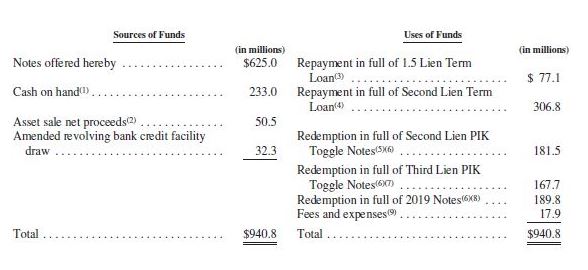
    Led by Morgan Stanley, the USD 625m second lien offering due 2023 is expected to roadshow through Thursday (4 September), pricing thereafter.

    Whispered in the 10% area, the bond effectively repays and retires all existing debt, according to deal documents—although in addition to the new bond, W&T will draw roughly USD 32m from its USD 250m revolver due 2022.

    “In an environment where we are starving for yield, some managers are definitely reaching into the energy sector in the hope of getting a yield kicker,” one buysider said.

    Pro forma the new bond deal, W&T’s leverage totals around 2.2x based on total pro forma debt of USD 657.3m and USD 300.5m in adjusted EBITDA booked over the LTM period ended 30 June, according to deal documents. Liquidity stands at USD 233m, with USD 208m of availability on its revolver due 2022 and USD 25m in cash, according to deal documents.

    By taking out near-term maturities W&T – the company has USD 536m in bond debt due between 2019 and 2021 now up for tender — will allow management the wherewithal to focus resources on increased production across existing and new reserves, two buysiders said.

    The company expects to receive 30% of the revenues from a recently entered JV Drilling Program for 14 identified drilling projects in the Gulf of Mexico over the next three years, according to company documents. The company also recently sold its ownership in a non-core asset in the Permian for USD 56.8m.

    Conservatively assuming adjusted EBITDA remains flat at USD 300.5m, the company should generate roughly USD 142.5m of cash (21.7% of total debt) in 2018, based on capex expected at roughly USD 95m and USD 63m of total pro forma interest expense, sources said.

    Crude awakening

    W&T joins the list of energy players including services company Basic Energy along with E&P’s such as Chesapeake Energy and Vine Oil & Gas that have successfully tapped the market as crude prices reach their highest since late 2014.

    WTI crude was last quoted at USD 76.07 per barrel, up 117% from its lowest point in 2016 at USD 34.99. Brent crude was last quoted at USD 85.77 per barrel, up 150% from its lowest point in 2016 at USD 34.37.

    “It makes sense for these issuers to come to market given positive momentum on crude,” one of the buysiders said. “All of these issuers are supported by better sentiment around commodity prices. And after the 2015 and 2016 debacle, a lot of them are coming back with cleaner balance sheets.”

    However, with the crude price downturn not too far in the rearview, some investors are hesitant to jump back into the volatile sector at large. “Offshore is an acquired taste. Oil prices are up, but people still think that the offshore part of the E&P industry is out of favor. They’re afraid of being burned like they were in 2016,” one buysider said.

    Offshore producers face weather implications as well, another buysider pointed out. “All it takes is one hurricane or Macondo-type event and a company can be done,” he said.

    W&T was able to survive the sector crash by deploying through a number of operational and financial strategies, including a distressed exchange in 2016.

    The capital structure has rallied this year, but the new bond is still expected to be priced expensively, and come wide to better capitalized peer shelf producers Talos Production and EnVen Energy Ventures, sources said.

    Gulf of Mexico-focused EnVen has over 2x PDP coverage and an expected FY18 leverage of 1.1x, compared to W&T’s 1.3x PDP coverage and pro forma 2.2x leverage, two sources said. Talon’s PDP coverage at 31 December was 1.1x and FY18 leverage is expected to come in near 1.2x, the sources added.

    W&T also estimated as of 31 December 2017 that 50% of its total proved reserves will be depleted within three years, according to deal documents. “If they go through with their projected drilling programs, then good for me. If not, buysiders have to factor that risk into the pricing as well,” one buysider said.

    W&T’s USD 189m 8.5% senior unsecured notes due 2019 last traded on Thursday (27 September) at 99.688 to yield 8.933% compared to trades in the 10/11 context in early 2016 before the exchange and when the principle amount of the bond was USD 900m, according to MarketAxess. The company’s shares traded today at USD 9.63 for a market cap of USD 1.34bn, up 394% from USD 1.95 a year ago and up 598% from USD 1.38 in 2016.

    Talos’s USD 390.9m 11% senior secured notes due 2022 last traded on Friday (28 September) at 107.5 to yield 7.182%, according to MarketAxess. EnVen’s USD 325m 11% second lien notes due 2023 last traded yesterday (2 October) at 110.75 to yield 7.33%, according to MarketAxess.

    Morgan Stanley declined to comment. W&T did not respond to a request for comment.

  • Chesapeake Energy’s USD 1.25bn dual-tranche driveby bond, which follows the sale of its Utica assets to Encino Energy, reduces interest expense and pushes the well-known issuer further towards cash flow neutrality, according to six buysiders and one sellsider following the deal.

    The company plans to use proceeds from the Goldman Sachs-led dual-tranche USD 1.25bn deal to repay outstanding borrowings on its USD 1.5bn L+750bps (1% floor) term loan due 2021 and fund general corporate purposes.

    The eight-year non-call three tranche is talked in the 7.5% area, while the six-year non-call 2.5-year tranche is talked in the 7% to 7.25% range, in line with whispers earlier today. Chesapeake’s existing USD 1.3bn 8% senior unsecured notes due 2025 traded today at 103 to yield 7.172%, up from recent trades in the 101/102 context, according to MarketAxess. Both tranches are rated B-/Caa1.

    Chesapeake, which has spent recent years grappling with a heavy debt load, is still burning cash. But the new deal will help reduce that cash burn as well as free up assets that were pledged to its secured credit facility, giving it more flexibility to handle upcoming maturities, sources said.

    The new bond offering should reduce Chesapeake’s annual interest expense by roughly USD 20m-25m, said two of the sources. By replacing secured debt with unsecured, the deal also gives Chesapeake more flexibility to handle its upcoming maturities, sources added.

    “The deal frees up debt capacity and incrementally moves them in the right direction to eventually becoming cash flow neutral,” said one buysider.

    Assuming LTM adjusted EBITDA remains more or less flat to the USD 2.443bn Chesapeake reported in 2Q18, the company should burn roughly USD 640m of cash in 2018, based on capex remaining flat at roughly USD 2.421bn and USD 666m of total pro forma interest expense, sources said.

    The company’s recent expansion in the Powder River Basin—as well as the potential use of its expected USD 2bn of proceeds from the Utica sale to pay down debt—could further reduce its cash burn, sources added.

    Pro forma the new bond deal, Chesapeake’s leverage is around 4x, based on total pro forma debt of USD 9.8bn, according to deal documents. Liquidity stands at USD 2.221bn, with USD 2.215bn of availability on a USD 3bn revolver due 2023 and USD 6m in cash.

    The transaction could attract investor interest relative to fellow E&P company Ascent Resources Utica, which is also in the market this week, three sources said. They said they preferred Chesapeake’s bonds to Ascent’s proposed BB-/B2 USD 600m senior unsecured notes due 2026, whispered in the 7% area, because of Chesapeake’s greater diversification and scale.

    Ascent’s USD 1.5bn 10% senior unsecured notes due 2022 traded yesterday (24 September) at 111.375 to yield 5.829%, according to MarketAxess.

    Goldman Sachs and Chesapeake did not respond to requests for comment.

  • Basic Energy is expected to press forward with its second attempt at refinancing its debt stack despite the double-digit yield investors are demanding, said seven buysiders tracking the situation. The oilfield servicer does not generate cash even with rising oil prices and has to contend with increased competition for its services.

    The company is in the market with a B3-rated USD 300m senior secured notes alongside a new USD 150m ABL facility. Proceeds will take out prepetition USD 161.7m 13.5% first lien term loan due 2021 – as well as a USD 17.5m repayment penalty – pay down the USD 90m outstanding on its ABL, and add cash to its balance sheet.

    Whispers on the BofA Merrill Lynch-led five-year non-call two notes are circulating in the 11% area, sources said. That is wider than 9.25%-9.5% whispers when Basic and BofA attempted to refinance its debt in March with a similar USD 300m first lien offering.

    The company held an investor call Thursday (20 September) and expects to wrap up the roadshow by Monday (24 September), with pricing expected thereafter.

    The deal brings pro forma liquidity to USD 252m, split between USD 102m of cash on hand and availability on its undrawn ABL. Pro forma leverage ticks up roughly half a turn to 3.4x based on LTM USD 112m adjusted EBITDA as of 30 June and USD 385m of pro forma debt – including USD 85m of capital leases.

    That figure is well below the 6.7x of pro forma leverage it marketed back in March, said the sources.

    Oil prices have trended higher since March, with WTI crude trading today at USD 71.14 per barrel, up roughly 14% compared to prices in early March at USD 62.60 per barrel.

    For 1H18 ended 30 June, Basic reported a 134% increase in year-over-year adjusted EBITDA to USD 50.26m compared to USD 21.5m a year earlier on improved oil prices and an increase in well activity. Revenue for 1H18 ended 30 June also increased 23% year-over-year to USD 488m from USD 395m a year earlier, according to company documents.

    “They’ve been cleaning up the balance sheet [and] their credit stats are a lot stronger for them to do a deal,” one buysider said.

    Nevertheless, the company’s shares have been hammered, in part because several of its competitors have merged and are now viewed as better operators, said the sources. Basic’s stock traded most recently at USD 9.16 for a market cap of USD 245m, down 48% from the deal’s launch in March and down 74% from post-bankruptcy emergence.

    Better than Basic

    While earnings have improved, investors note the company has underinvested in its assets and may not be suited to operate in the event of another energy downturn.

    By comparison, industry peers have consolidated in the Permian Basin, and are now better capitalized, said the sources. The region is viewed as Basin’s core operating area and the company could struggle to gain pricing power, given its small size relative to peers.

    Just this month, EagleClaw Midstream and Transocean announced acquisitions; Southwestern Energy announced an asset sale; and Ares acquired Paradigm Energy Partners.

    “When the industry catches a cold, this one [Basic] catches black death. It’s more product limited [and] it’s not broadly diversified,” one sellsider said.

    Basic’s service offerings can be divided into four segments: completion and remedial services, which focuses mostly on pumping, cementing, and fracturing (51% of LTM revenue), well servicing (24% of LTM revenue), water logistics (23% of LTM revenue) and contract drilling (1% of LTM revenue), deal documents show.

    The company is expected to burn USD 13m of cash in 2018, based on adjusted EBITDA projections of USD 100m, pro forma interest expense of USD 33m, and capex of USD 80m. Meanwhile, 2019 estimates imply continued cash burn given flat EBITDA projections and similar interest and capex projections, according to two buysiders.

    “The oil business has been robust over last six months and they’ve shown an inability to make as much money as they can, and that’s because of their assets,” a buysider said.

    Also working against the company’s ability to throw off cash is the rising cost of labor for Basic and other service companies, two buysiders said.

    Basic’s direct operating expenses, which primarily consist of labor, fuel and insurance, increased 18% year-over-year for 1H18 compared to 1H17, mostly in its completion and remedial services and well servicing segments, according to company documents.

    “They [Basic] don’t have the manpower to contend with those labor requirements and they’re not big enough to withstand the consolidation trend there,” one buysider said.

    Buysiders expect Basic to price wider than larger servicers 3.6x levered Calfrac and 14.1x levered Weatherford, said the sources. Both companies are viewed as more competitive in the Permian basin, they said.

    Calfrac’s USD 650m 8.5% senior unsecured notes due 2026 last traded at 93 to yield 9.807%, according to MarketAxess. Weatherford’s USD 750m 8.25% senior unsecured notes due 2023 last traded today at 93.25 to yield 10.075%, according to MarketAxess.

    Basic raised the initial USD 165m term loan in 2016 from Riverstone Energy and West Street Capital and filed for Chapter 11 later that year, handing equity to holders of its pre-petition USD 775m of unsecured notes and reinstating the term loan.

    The company did not respond to a request for comment. The bank declined to comment.

  • Schweitzer-Mauduit International’s debut bond deal offers a slight pickup to the high yield index and exposure to a diverse set of revenue streams designed to withstand an economic downturn, according to six sources following the transaction.

    The deal is a bright spot in a market where high leverage and worsening covenant protections have many buysiders fretting about downside protection, sources said.

    Schweitzer, which makes specialized paper products such as cigarette rolling papers and advanced materials for products such as water filters, is whispering USD 350m of senior unsecured notes due 2026 at 6.5%-6.75%. The JPMorgan-led roadshow runs through Friday with pricing expected thereafter.

    Along with the BB-/B2 rated notes, the issuer is entering into a new USD 700m credit facility comprising a USD 200m TLA due 2025 and a USD 500m revolver which will be partially drawn at close, the sources added.

    Proceeds of the transaction fund the repayment of the company’s existing TLA-1 due 2020 and refinance the existing TLA-2 due 2022 and existing revolver due 2020. Pro forma liquidity will be USD 478m with roughly USD 74m of cash on hand and USD 404m of availability under its new USD 500m revolver.
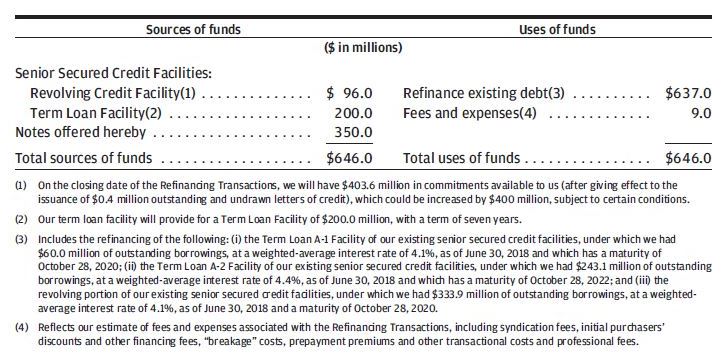
    Pro forma leverage is 3.21x (compared to 3.16x previously) based on total debt of USD 656.8m and USD 204.9m adjusted LTM EBITDA as of 30 June, according to deal documents. During the lender call, company executives said they would consider taking leverage as high as 3.5x to make acquisitions, but otherwise the goal is to delever to 3x or less, one of the sources added.

    Playing defense

    With concerns festering the market about a looming turn in the credit cycle, Schweitzer’s deal offers a defensive option—a mix of businesses less susceptible to cyclicality, with digestible leverage and a reasonable covenant package, according to the sources.

    The deal also offers a slight pickup in pricing to the broader market—the comparably rated portion of the ICE BAML High Yield Index was last quoted at 5.07% today.

    Several prospective investors weighing the deal said they expect the company to generate USD 70m-USD 80m of free cash flow (11%-12% of total debt) based on flat USD 205m LTM EBITDA, USD 50m-USD 60m for dividends, USD 40m of capex and USD 35m of interest expense.

    The company reported net sales growth through the 2008/2009 global financial crisis, according to SEC filings. Schweitzer has also invested over recent years to reduce its reliance on the tobacco sector, where sales are declining in developed markets. Some 49% of net sales came from the engineered papers business in 2017, down from 94% in 2012, according to SEC filings. Its advanced materials and structures business serves the infrastructure and construction, filtration, transportation, industrial and medical sectors.

    “Their products aren’t cyclical,” said one buysider. “They might get hit by the trend towards e-cigs, Juuls and whatnot, but overall, their other products will help couch the blow.”

    The company has also stayed on top of new developments in the tobacco space, sources pointed out. For example, it carries “heat-not-burn” tobacco products—marketed as more authentic than vaping but healthier than traditional cigarettes—and developed flame-retardant rolling paper, which is required in Europe to comply with safety regulations.

    In what has been seen as a blow to the burgeoning e-cig industry, the Food and Drug Administration on Wednesday notified makers of e-cigarettes that they had just 60 days to prove they halt sales of their devices to minors, citing an “epidemic proportion” of vaping among teens.

    “Theoretically that is positive for [Schweitzer] but they had already been diversifying away from their tobacco business anyway,” said another buysider.

    Adding to the attraction of the company’s diversified business mix and modest leverage, the deal also contains a full suite of high yield covenants, according to a report from Xtract Research. That stands in contrast to many other deals in the market, such as online car retailer Carvana’s debut deal, which Xtract said had a “surprisingly weak” covenant package.

    Patent expiration

    As of 30 June, the company owned roughly 50 patents in its AMS segment and about 200 patents in its EP segment, according to deal documents. It has more than 50 pending patent applications in AMS and 100 in its EP segment.

    The company cited patent expiration in the deal’s risk factors, but executives said they had been working to establish strong market share before this happens.

    “They’ve been good with working with customers to give price concessions and build market share to protect their piece when the patent goes,” one of the buysiders said, referring to the flame-retardant papers product.

    Because of the wide range of end-markets Schweitzer services, buysiders referenced similarly rated industrial companies including packaging company TriMas and manufacturer Actuant Corporation as comps. Two sources also mentioned Altra Industrial Motion, which is currently marketing a USD 1.34bn TLB.

    Sources used TriMas and Actuant as comparison points for Schweitzer’s advanced materials and structures segment, though the companies target different industries.

    “There isn’t a company that straddles the two things that [Schweitzer is] doing here,” said one of the sources. “They all reach industrial and infrastructure in some way, but TriMas has a place in the aerospace and energy sectors and Actuant reaches mining and energy, rather than tobacco like Schweitzer.”

    TriMas is 1.8x levered, and its USD 300m 4.875% senior unsecured notes last traded at 96.25 to yield 5.517% on 23 August, according to MarketAxess. Actuant, which is 4x levered, has USD 300m 5.625% senior unsecured notes that last traded at 102.1 to yield 4.066% on 29 August.

    Altra is marketing its TLB at L+275bps-300bps (0% floor) with a 99.5 OID. Its pro forma net leverage is roughly 4x, according to a source close to that transaction.

    Schweitzer did not respond to a request for comment. JPMorgan declined to comment.
  • Large chunks of Rex Energy second lien bonds have been changing hands in block trades this week following the debtor’s approval of its sale to PennEnergy, according to two sources familiar with the company.

    Among the large sellers has been Franklin Resources, which offloaded roughly 100m, said the sources. The buyers include Farallon Asset Management and Weiss Asset Management, a Boston-based firm that bought roughly 30m of the bonds, added one of the sources.

    Franklin sold its block of the USD 610m second lien notes due 2020 around 27.5, while Weiss and Farallon bought in at similar levels, the sources added.

    According to MarketAxess, the notes last traded at 27.613, compared to Rex’s second lien recovery value of 26%, coming from a USD 162m cash payment.

    The move to buy in at a slight premium to recovery levels may give buyers incentive to stir for nuisance value in a push for higher recoveries, sources said. Previously in the case, the second lien group – led by Franklin Resources, Loomis Sayles and Mackay Shields – had been trying a purchase of the company, but ultimately lost out to Penn in the auction, as reported by Debtwire. Now, the influx of new creditor constituents could signal last minute game theories at play, likely predicated on projections for rising oil prices, the sources added.

    The debtor’s restructuring support agreement (RSA) was previously backed by all of its first lien lenders and 72% of its second liens.

    Franklin, Farallon and Weiss did not respond to requests for comment.

    [Editor’s note: This story has been updated since initial publication to include reporting that Farallon was one of the buyers.]

  • Avolon’s unsecured bond driveby today ticks another box in the BB+/Ba2 rated aircraft lessor’s path to becoming an investment grade credit, said four buyside sources.

    The company plans to use proceeds from the upsized JPMorgan-led five-year USD 1bn bullet to refinance secured debt – which includes a USD 4.75bn Libor+ 200bps TLB due 2025 – and fund general corporate purposes.

    Swapping out secured debt for more unsecured will position Avolon with a lower ratio of secured debt to tangible assets as it moves toward attaining IG requirements set by ratings agencies. Moody’s caps the ratio at 30% for IG credits, two of the sources said.

    “The bond doesn’t get them there, but it makes an impact and the threshold is within their reach,” one of the sources said.

    As of 31 March, the company’s ratio stood at 49% on a gross basis and 45% on an adjusted basis, according to two sources. At best, if the company uses all proceeds to lower its outstanding secured debt, the gross ratio will be a little higher than 40%, one of sources estimated. Normalized for a period of excess cash holding, on debt-to-equity basis, leverage is expected to stay around 2.8x, one of the sources added.

    Avolon priced the notes offering this afternoon at 5.125% and par, in line with whispers from earlier today, a trader and a buysider said.

    On the break, the notes traded up to 100.25 for a yield of 5.07%, according to the buysider.

    In early August, Bohai Capital, the company’s direct parent, agreed to sell a 30% stake to ORIX Corp for USD 2.2bn. That prompted Moody’s to put Avolon’s rating on review for upgrade, citing “the significant investment commitment by ORIX…as well as an expected reduction in Avolon’s governance risks.” The transaction is expected to close in 4Q18, pending Bohai shareholder approval.

    Although Bohai didn’t sell a controlling stake, investors received some assurance that Bohai will need approval from ORIX’s directors for both board-reserved and shareholder-reserved matters going forward, sources said.

    “The concern was always that if the parent comes under stress, then they could do bondholder-unfriendly things. Bohai has to now run things by ORIX. It draws a line as to what Bohai can do,” one of the buysiders said.

    Avolon’s board of directors is expected to consist of two seats for ORIX, three seats for Bohai, an independent director appointed by Bohai and ORIX and CEO Domhnal Slattery, sources said. All board-reserved matters will require a simple majority from the board, while all shareholder-reserved matters, including any affiliate transactions and major expenditures, will require six out of seven votes, the sources added.

    “With the proposed investment by ORIX and the related revisions to its governance structure, both of which we view favorably, we would now assess Avolon as de-linked from Bohai as well,” S&P said in today’s credit rating report.

    Avolon tightened covenants in February to ease investor concerns while the company’s ultimate Chinese parent, HNA, went through a liquidity crunch, as reported by Debtwire. Namely, the lessor added a mandatory redemption covenant, a general basket for shareholder payments and a builder basket for consolidated net income and incremental capital distribution.

    Avolon’s existing USD 5.25% senior unsecured notes due 2022 traded today at 101.5 to yield 4.825%, down from 102.25 on 4 September, but up from prints at par at the end of July before the ORIX announcement, according to MarketAxess.

    Its USD 4.75bn L+200bps (75bps floor) TLB due 2025 is quoted today in the 99.86/100.22 context, in line with levels this month, higher than quotes in the 99.228/99.58 context before the ORIX announcement.

    Avolon and JPM declined to comment.

  • FXI Holdings (aka Foamex Innovations) reported an increase in revenue in 2Q18, though EBITDA dipped slightly amid higher costs, said two sources familiar with the matter. Meanwhile the company also boosted liquidity with a sale leaseback deal, and aims to deploy proceeds toward tuck-in acquisitions, they said.

    FXI sold six US properties and one in Mexico for a total of USD 109.5m, the sources said. Management said on the earnings call yesterday that they would pursue tuck-ins aimed at offsetting weakness in the auto and medical technology markets, the sources said.

    Pro forma the sale leaseback, FXI’s total gross leverage and net leverage came to 5.5x and 3.8x, respectively, based on LTM EBITDA of USD 98.7m and USD 543m of total debt. Following the potential acquisitions, management aims to keep gross total leverage around 5x, according to the sources.

    FXI’s USD 525m 7.875% senior secured notes due 2024 traded as low as 96.25 to yield 8.67% last week after the earnings report, from prints at 98 in early August, according to MarketAxess. The notes recovered slightly to last trade at 96.75 on Monday (27 August).

    The foam provider booked USD 230m in net sales at 2Q, up 6% year-over-year, primarily related to market price increases due to rising input costs and higher net sales in FXI’s direct-to-consumer mattress sales channel – partially offset by lower net sales to the company’s traditional home furnishings customers, sources said. The USD 230m in net sales came in slightly higher than market estimates of USD 225m, the sources added.

    Adjusted EBITDA for the quarter decreased by 6% to USD 27m, but came in higher than market estimates of USD 25m, primarily related to higher manufacturing costs in the home furnishings business unit, excluding the DTC mattress channel, incurred in connection with the launch of new products, sources said.

    Investors expect the company to generate USD 30m of free cash flow in fiscal year 2018, with USD 100m of expected EBITDA, USD 21m of capex and USD 43m of interest.

    Of note, sales in the transportation segment steadied for the quarter, increasing 0.4% YoY, after several years of trending downward, one of the sources pointed out. The segment typically contributes just under half of the company’s revenue, and has declined to USD 200m in 1H18 from USD 205m in 1H17 and USD 207m in 1H16.

    Management said that automaker destocking, amid softer auto sales, has contributed to lower volumes in FXI’s transportation segment, a source added. Though US automobile sales showed year-over-year volume growth from 2015 to 2016 – reaching historic levels of over 17m units sold annually – 2017 marked the beginning of a pullback from the peak, according to the seasonally adjusted, annualized rate of sales (SAAR) as calculated by IHS Markit.

    And looking ahead, 2018 so far is slightly softer with the SAAR estimate as of July falling to 16.73m, the weakest reading since a reported 16.58m in August 2017 due to Hurricane Harvey.

    FXI’s ability to generate revenue growth in its transportation unit is largely dependent on an overall uptick in auto sales, one of the sources said. More recently, its growth has come from the bedding side. “The company got a boost in demand from online mattress companies, which showed revenue growth, some of which was driven by cost increases,” he added.

    The company’s home furnishings segment revenue for the first half of 2018 totaled USD 214.7m (47% of total 1H18 revenue), up 16% YoY from USD 185.2m (42% of total 1H17 revenue), according to sources.

    FXI’s liquidity totaled around USD 257m at quarter end, including USD 168m in cash and USD 89m of revolver availability, sources said.

    The company tapped the market in October 2017 for the 2024 notes to fund its acquisition by One Rock Capital, according to Debtwire data.

    A representative for FXI said the company does not comment publicly on financial matters.

  • Husky Injection Molding and Anchor Glass Container both delivered disappointing earnings for the second quarter, leading their respective debt to trade down in secondary markets.

    Husky’s costs increased while sales declined in the wake of its highly levered buyout by Platinum Equity earlier this year. Anchor Glass attributed its earnings drop to a fire at one of its plants in May but also cautioned it was searching for a client to replace Dr Pepper Snapple Group, which is transitioning to plastic bottles rather than glass.

    In this podcast, recorded Friday 24 August, Will Caiger-Smith, associate editor for primary markets at Debtwire, and Farhin Lilywala, high yield reporter for Debtwire, discuss the outlook for both companies in light of their second quarter earnings.

    CLICK HERE to listen to the podcast

  • Anchor Glass Container’s 2Q18 EBITDA fell 24% year-over-year, while revenue also softened by 5%, said two sources familiar with the matter. The company attributed the declines to a fire at one of its plants in May, and said the earnings impact from that event should be isolated to 2Q.

    The CVC Capital Partners-owned company’s loans eased lower after the earnings report, which showed unexpectedly high SG&A costs, one of the sources said. Furthermore, the company on 3 August entered into a settlement with the US Department of Justice and the Environmental Protection Agency for a USD 1.1m fine and USD 600,000 in mitigation costs related to alleged Clean Air Act violations.

    Looking ahead, the company’s earnings are expected to remain under pressure as Dr Pepper Snapple Group, one of its main customers, transitions to more plastic bottles rather than glass.

    The company generated adjusted EBITDA of approximately USD 33m in 2Q18, compared to USD 43m in 2Q17, a third source said. The results bring LTM pro forma credit agreement adjusted EBITDA to around USD 126m, putting leverage at 5.1x through the first lien and 6.3x total, before accounting for any revolver borrowings.

    Anchor’s USD 647m Libor+ 275bps (1% floor) TLB due 2023 is quoted in the 88/89.64 context, down from 90.19/91.64 at the end of July, but up from a low of 87.46/88.96 on 17 August, according to Markit. Its USD 150m L+ 775bps (1% floor) second lien TL due 2024 moved down to 62.25/65.375, from 64/69 before the earnings, but have since climbed back up over a point to 63.75/65.625.

    During 2Q, volumes fell 10%, while prices increased by 5% compared to 2Q17, sources said. SG&A accounted for 15% of the sales, which sources qualified as relatively high.

    “If sales are weak, SG&A is one thing that is in their own control so it’s worrying that it was so high,” one of the sources said.

    In February, Snapple announced that the beverage company will seek packaging from plastic sources, rather than glass. For 1Q18, the Snapple contract was worth roughly USD 30m in quarterly revenue to Anchor, roughly 22% of the issuer’s USD 135m 1Q18 revenue, sources said.

    Anchor’s management team said they are looking to replace the revenue from Snapple with a higher-margin business.

    “I think you can fix and replace some of the volumes that are lost [from Snapple], but I don’t know what they’re going to be able to replace it with that’s going to sustain the current capital structure. I don’t know if it will be enough,” one of the lenders said.

    CVC bought Anchor in late 2016 for over USD 1bn, from former sponsor KPS Capital Partners, with the help of a Credit Suisse-led first and second lien loan facility. Anchor repriced the first lien in July 2017.

    Anchor did not respond to requests for comment. CVC declined comment.