-
What do you think a homeless person’s day consist of?
-
By Claire Boston, University of Missouri , Farhin Lilywala, Georgia Perimeter College, Melhor Leonor, Florida International University, Sean Stewart-Muniz, University of Florida and Nicole Wiesenthal, University of Florida
On the night of Aug. 31, Linda Lampert was on a mission. She had been living in the homeless shelter for five months and knew a man who slept in a thicket of sea grapes near Dania Beach.
She disappeared into the thicket while COSAC shelter staff stood by. The group regularly goes on such excursions to coax homeless men and women who sleep outdoors to come to the shelter.
“It’s a psychological game of chess, a different chess game. Tryin’ to convince someone you have something better for them,” said Ron Gauthier, operations staff member at COSAC, who was homeless at one point. “Ultimately, the choice is theirs.”
‘At least you’ve done something.’


Gauthier has driven on outreach trips nine of the ten years he’s worked with COSAC. He’ll make four or five trips a year, and has varying success in getting people off the streets. Sometimes, especially in colder months, he’ll convince them to come into the shelter. He said most only stay a night, but that’s enough time to get fresh clothes, a meal, a hot shower and a night’s sleep.
“It’s worth it because we got someone off the street,” Gauthier said.
Most shelter residents come in on their own volition, but Gauthier said the point of outreach is to make sure those further from the shelter know that it exists.
“All you can do is give them the same opportunity as the ones who walk in of the street,” Gauthier said. “At least you’ve done something.”
Gauthier has had enough shelter jobs to fill a resume. As a shelter resident, he worked as a Homeless Voice vendor and ran the kitchen. He later kept track of van maintenance and began driving the ambulance. He’s stuck with his ambulance driving job, even after leaving the shelter and moving into his own place.

The ambulance is a tippy old thing with shoddy circuitry. The air conditioning rattles away but blows no cool air. Lights in the back turn on and off at random. Sometimes, the ambulance’s emergency lights flash too.
Gauthier is only authorized to turn on the lights on for real emergencies like natural disasters. But they flickered a couple times when he was on the road. At one point, a line of cars at a red light began pulling to the side.
He said driving the ambulance and doing outreach is a way of giving back to a shelter that once helped him. And even if outreach rarely results in new clients, Gauthier said he plans on continuing with the work for the rest of his life.
“It’s not a game of winning or losing,” Gauthier said of getting people off the streets. “It’s a game of believing and trusting that you’re doing the right thing.”
‘Sick and tired of being sick and tired’
In one of the vans tailing the ambulance, Andrew and Alex Johnson traded jokes heavy with thickened vowels and trailing consonants.
The two met six years ago in the shelter and bonded over shared experiences: both men are veterans of homelessness. They come from rough backgrounds — drugs, crime and broken families.
Both have been on and off the streets for decades.
After working off their rent at the shelter and earning their driver’s licenses from the state, Andrew and Alex decided to help those much like their former selves.
Andrew battled a crack addiction that led to his homelessness in the 1980s. The drug continued to haunt him as he passed in and out of homeless shelters, never staying for longer than a few weeks.
His brother introduced him to drugs after their mother died, and his addiction to crack started soon after. He said the vans he drives now didn’t reach deep enough into the ghetto to bring him help — but he wasn’t ready for it anyway.
He said many homeless people feel the same and refuse aid when the shelter’s vans pull up. Some want independence, others don’t want to risk easy access to drugs.
The biting loneliness led him to seek help. After what was left of his family turned its back on him for stealing a TV and cash from their house, he had no place to go and no one to turn to.
“No family, no football, no basketball,” Andrew said.
Alex took addiction to the next step — he started selling crack.
It was easy money, and with family deaths causing flare-ups for his schizophrenia, it kept him funded while he was on the streets.
But a roughly seven-year prison sentence for a probation violation convinced him to try a more honest path.
“I was sick and tired of being sick and tired,” he said.
After frequenting the government-run shelters in Broward County, he found a home at COSAC, a shelter run by the formerly homeless.
Now Andrew and Alex work as a team to bring people off the same streets that fed their addictions.

‘They’re more comfortable where they are’
Lampert herself was found on one of these excursions. She was laying on top of a piece of cardboard near a tree sleeping and wary that somebody would steal her belongings.
“Honey, you don’t know who’s going to rob you, take your shoes,” Lampert said. “You think you’re gonna [find me] in the woods? Nope. Heavens no!”
After many nights outdoors, she learned how to survive.
“Rule number one: you always sit in a crowd,” Lampert said.
The man she was looking for the night of Aug. 31, known to everyone as Alfie, was part of her crowd. They partnered for a while, but when it got cold last winter, she decided to get in the van and go to the shelter. At the time, he refused.
“They’re more comfortable where they are,” Lampert said.
This time, she hoped he would change his mind.
After ten minutes within the dark bushes and with the team standing by, Lampert emerged with Alfie on her trail.
“I just told him, ‘come,’” Lampert said.
He was leaning on a walker, graying, and exuding a foul smell. She was cautious about letting the staff speak to him, fearful he would change his mind.
In the end, Alfie chose to not stay.
-
(Ferguson, Mo.)- What really happened? Here are six things to know about Ferguson:
1. Michael Brown, 18, and his friend, Dorian Johson, 22, were walking down the street, and a police officer confronted them for walking on the street.
2. There was some sort of a struggle between Brown and police officer Darren Wilson through Wilson’s car window.
3. Brown was not armed. This is confirmed by all parties, according to major news outlets.
4. Brown was shot at least six times, according to autopsy reports, twice in the head.
5. Brown was allegedly a prime suspect in a convenience store robbery that occurred the day of his death. A store surveillance tape shows Brown to be the robber. Also, according to Benjamin Crump, the Brown family lawyer, the man in the video appears to be Brown.
6.The police took six days to publicly identify Wilson as the officer who killed Brown.
(Syria)- Journalist Peter Theo Curits, 45, is said to have been kidnapped by the al-Nusra Font, a Syrian group with ties to al-Qaeda, in October 2012. He was released on Sunday, Aug. 24. Curits was moved to the U.N. in Golan Heights. Doctors conducted a check-up on him to ensure there was nothing physically wrong. He is expected to reunite with his family soon.
(Liberia)- Ebola is known as one of the deadliest dieseases to contract. The disease is extremely fatal and has no cure. In Liberia, the doctor who contracted the virus and was given a hopeful experimental drug has died. This is considered to be the deadliest outbreak of the Ebola virus in history.
Ebola first broke out in Guinea in March. It was not considered a matter of the highest priority at the time, because there were very few cases. After that, 909 confirmed cases and perhaps another 414 cases are thought to be in Guinea, Sierra Leone, and Nigeria.
Some 729 people of the 1,323 total confirmed and possible infections have died, reports World Health Organization as of July 27.
Compiled by Farhin Lilywala, editor-in-chief. Source: CNN.
-
By Farhin Lilywala
Creeper on Campus
On July 28, at 1:15 p.m., an officer called for assistance with a suspicious person in the F building, room 2230, on the Clarkston campus. The officer already on the scene questioned the victim, who said the suspect was following her. Meanwhile the second officer watched the suspect, who was very anxious. The suspect stated that he was a student on the Deactur campus. When asked for identification, he said he did not have his GPC ID or his license. The first officer then called dispatch to check the suspect’s record. The second officer conducted a ‘pat down.’ During this search, the victim’s license, Wells Fargo bank card, two credit cards, and a personal check were found in the suspect’s pockets. The victim’s purse was found in a trash can on the same floor. All of the stolen items were returned to the victim. The suspect was apprehended and trans- ported to the DeKalb County Jail. This case is now closed.
The Stolen J-Card
On Aug. 20, dispatch received a call at 5 p.m. At approximately 4 p.m. in building G on the Clarkston campus, a student’s J- Card was stolen. The victim checked out a basketball and gave his card to the desk. The suspect pretended to be the victim’s friend, returned a basketball, and said he would take the card back to the victim. The card was, in fact, never returned. The suspect made a few purchases using the victim’s card as well. He or she spent $4.00 at the Campus Cafe at 4:07 p.m. At 4:09 p.m., the suspect spent another $13.00 at the Campus Cafe. The biggest purchase, however, was at 4:31 p.m. at the GPC Bookstore, where the suspect spent $427.00. There are three suspects recorded on camera. The investigation continues.
Notes from GPC Public Safety:
Please be careful where you leave your belongings. If you bring an item of value on to campus, please know where it is at all times.
North Indian Creek Drive has now turned into a single-laned road by the Clarkston campus. There are many crosswalks that intersect the road. Please be mindful of pedestrains. If a city or GPC officer finds you in violation of this law, you will be penalized. Be safe.
Information provided by GPC Public Safety
-
By Farhin Lilywala
Every year since kindergarten, we received a school supply list. We could drive over to the nearest Walmart, buy the necessary items, and feel prepared for the first day of school. When we get to college, however, we are expected to know what we need and what we do not need. Although most professors have their own requirements, here are some supplies that you will need across the board:
Pens: While pencils are great for language and math classes, pens are the preferable choice of writing utensil for most professors. Pens, especially black pens, create a more finite look on paper, as opposed to the many eraser marks otherwise on paper. Pencils are more useful for taking tests on scantrons (which can be bought in the bookstore).
Spiral notebooks: Buying reams of paper and keeping up with loose sheets can be a hassle. With a spiral notebook, all of your papers are in one place. Therefore, you are more organized, and your notes are in chronological order. Also, most spiral notebooks have pockets to keep loose papers your professor passes out. If the papers do not fit in the pockets, then you can buy a folder to keep the singular papers in.
Sticky notes: No matter which subject you take, you will need to take notes and mark certain important things; sticky notes allow you to do so. Also, sticky notes serve as reminders for important deadlines.
Highlighters: In at least one of your classes, you will more than likely need to mark something important in your book. Highlighters let you mark and color-code these important facts.
Hopefully, this list gives you a better idea of what you need for college. Oh, and remember that you are at GPC to gain knowledge. So, go out, and find knowledge under every rock and every leaf. School, no matter what the grade, is to know as much as we can about the world so that we may make informed decisions and develop sound opinions.
-
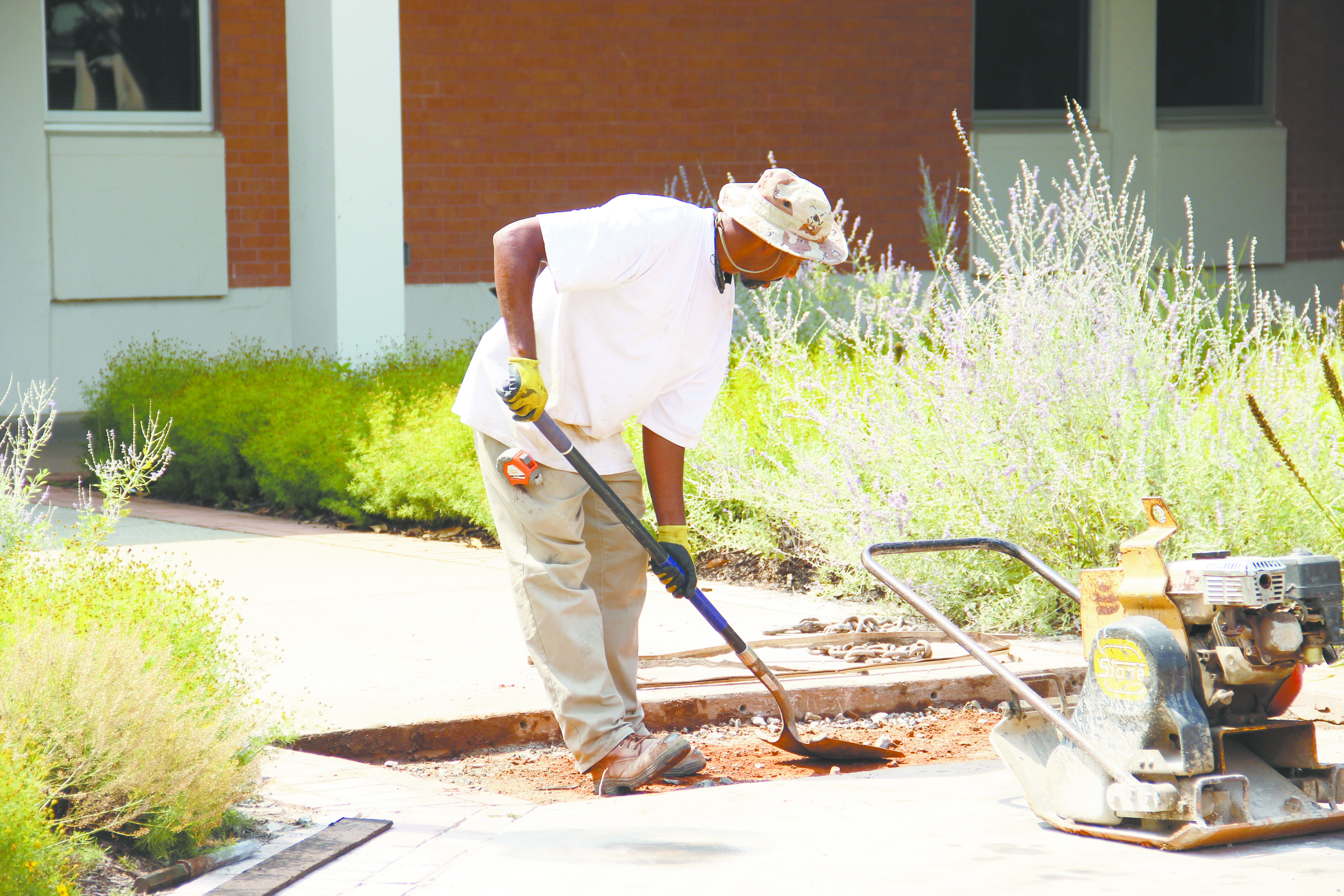
Construction worker Darrell Dixon shovels gravel to repair the sidewalk. Photo by Farhin Lilywala. -

From left to right: Construction workers Paul Kent, Darrell Dixon, and Chris Kent work hard to repair GPC’s sidewalks. Photo by Farhin Lilywala.